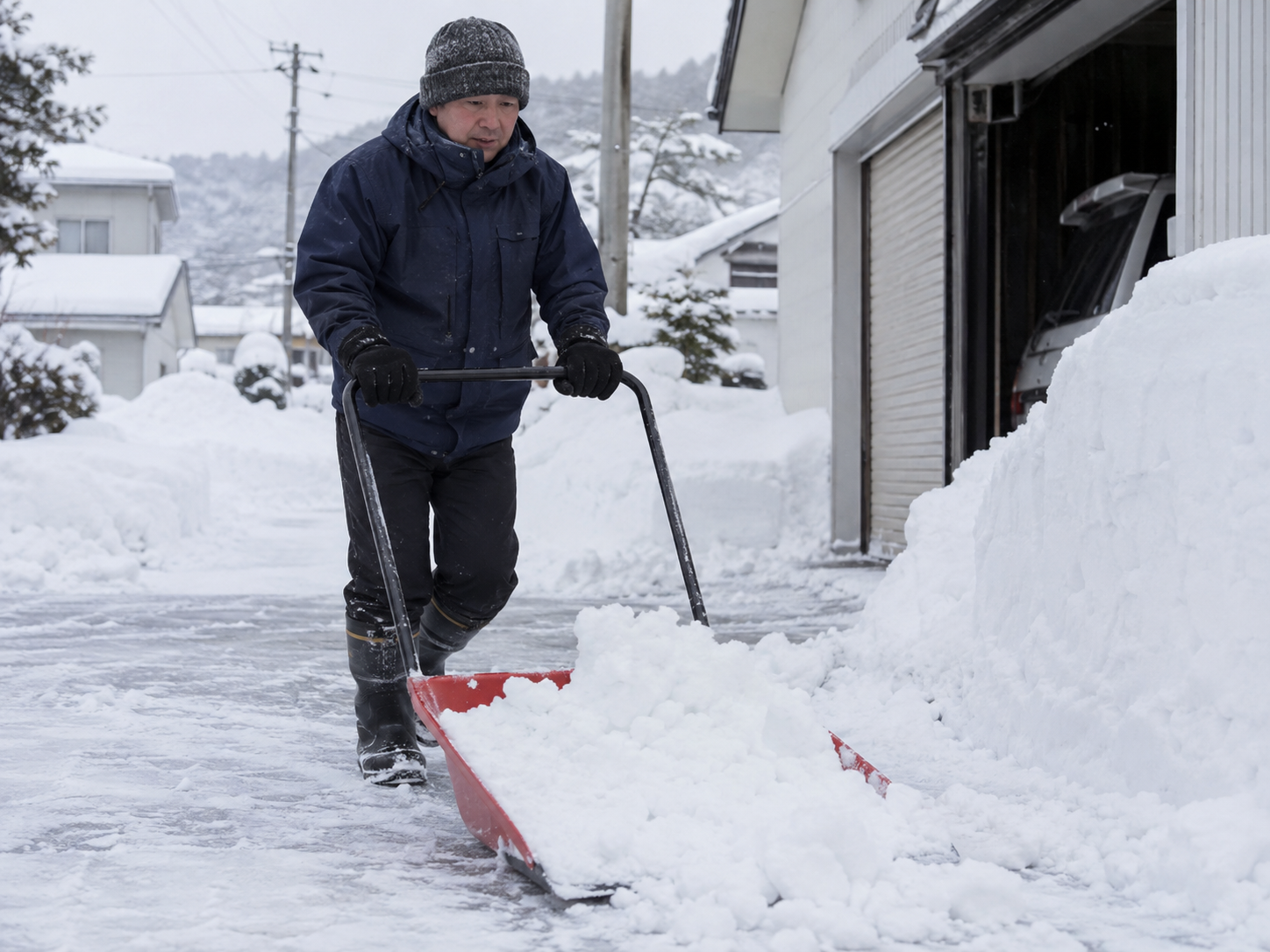
If you spend a winter in Hokkaido, Japan, you may see a strange-looking snow removal tool that looks like a giant shovel crossed with a sled.
In Japan, it is commonly called a snow dump (スノーダンプ). You may also hear the name Mama-san Dump (ママさんダンプ).
In English, similar tools may be described as a snow scoop, snow sled shovel, or sleigh shovel.
I’m from Hokkaido, so this kind of tool is a very familiar part of winter life to me.
If you have only used a regular snow shovel, the design may look unusual at first.
But when you need to move a large amount of snow, especially over and over again throughout winter, it makes a lot of sense.
The featured and illustrative images in this article are AI-generated.
- What Is a Japanese Snow Dump?
- Why Is It Called a “Snow Dump” in Japan?
- Snow Dump vs. Regular Snow Shovel
- Why Are Snow Dumps Useful in Hokkaido?
- What Does a Japanese Snow Dump Look Like?
- Things I Learned From Actually Using a Snow Dump in Hokkaido
- Is a Snow Dump Good for Heavy Wet Snow?
- Can You Buy a Japanese Snow Dump Outside Japan?
- Is a Snow Dump Better Than a Regular Snow Shovel?
- Final Thoughts
What Is a Japanese Snow Dump?
A Japanese snow dump is a large manual snow-removal tool designed to collect and move snow without constantly lifting it with your arms.
The tray is much larger than a normal snow shovel and slides across the snowy ground almost like a sled.
The basic way to use it is simple:
- Push the snow dump into the snow.
- Collect snow in the tray.
- Push or slide the loaded tool to another location.
- Tip it forward and dump the snow onto a snowbank or designated snow pile.
It is especially useful for moving snow around:
- Driveways
- Parking areas
- Garage entrances
- Paths around houses
- Larger residential properties
The important point is that a snow dump is not mainly designed for throwing snow.
It is designed for transporting it.
Why Is It Called a “Snow Dump” in Japan?
Snow-removal tools developed in their own way in Hokkaido and other snowy regions of Japan.
According to the Hokkaido Museum, a snow-pushing tool called yukioshi became common around the 1950s, particularly around railway stations.
The design was later commercialized for household use and became widely known as the Mama-san Dump or Snow Dump.
Today, household snow dumps usually have a large plastic or polycarbonate-style tray.
The handle is commonly made from metal tubing, and some models have a reinforced front edge.
The name “snow dump,” however, is not widely used in English-speaking countries.
Similar tools may instead be sold under names such as:
- Snow scoop
- Snow sled shovel
- Snow pusher
- Sleigh shovel
So if you live outside Japan and want to find something similar, those search terms may work better.
Snow Dump vs. Regular Snow Shovel
The biggest difference is not simply size.
It is how the snow is moved.
With a normal snow shovel, the process is usually:
Scoop → Lift → Carry or Throw
With a snow dump, it is more like:
Push → Load → Slide → Dump
That difference becomes important when there is a lot of snow.
A normal shovel is still better for:
- Stairs
- Tight spaces
- Corners
- Breaking up packed snow
- Small cleanup jobs
A snow dump is better when you need to move a larger volume of snow from one place to another.
Why Are Snow Dumps Useful in Hokkaido?
In Hokkaido, removing snow is not something you necessarily do once and forget about.
During winter, it can become a regular part of everyday life.
If you have to move the same kind of snow day after day, repeatedly lifting it with a shovel can be tiring.
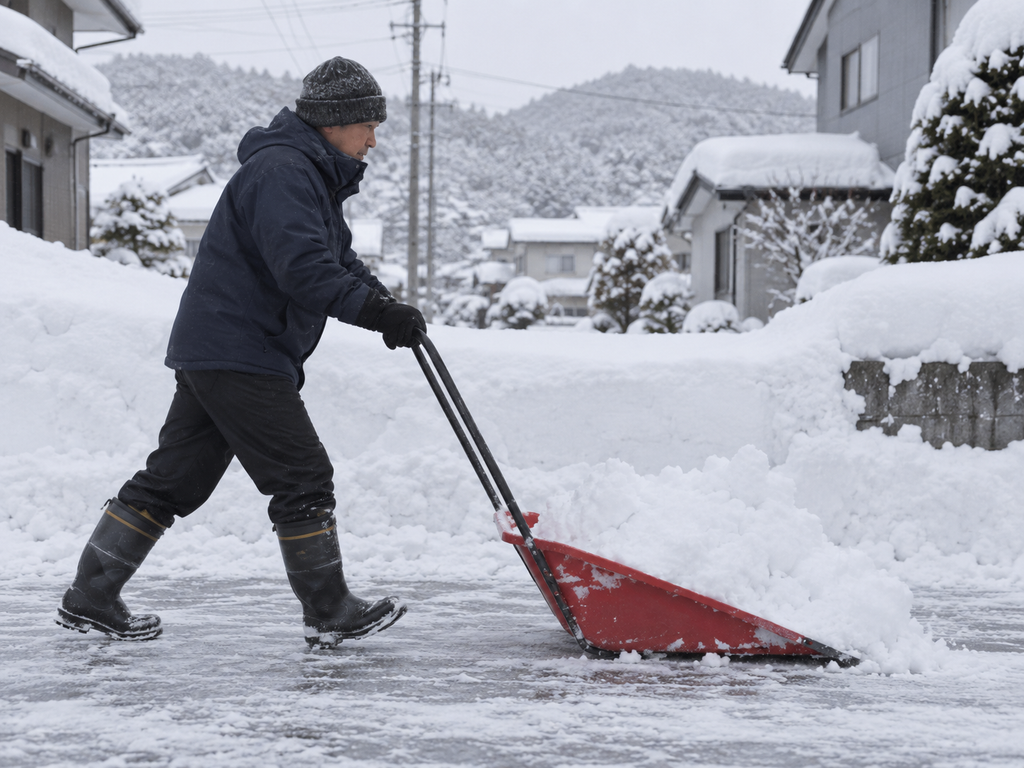
A snow dump lets you move a larger amount while keeping most of the weight close to the ground.
It is useful for jobs such as:
- Clearing a driveway
- Moving snow away from a house
- Clearing around parked cars
- Carrying snow to an existing snow pile
- Moving snow that has already been loosened with a shovel
In practice, a shovel and a snow dump often work well together.
You can break up or collect the snow with a shovel and then use the snow dump to transport it.
What Does a Japanese Snow Dump Look Like?
Most household models have three main parts.
A Large Tray
This is where the snow is collected.
It can carry considerably more snow than an ordinary shovel.
A Long U-Shaped Handle
You hold the handle with both hands and push the tool forward.
A Sliding Bottom
A typical snow dump does not use wheels.
Instead, the bottom of the tray slides over the snow like a sled.
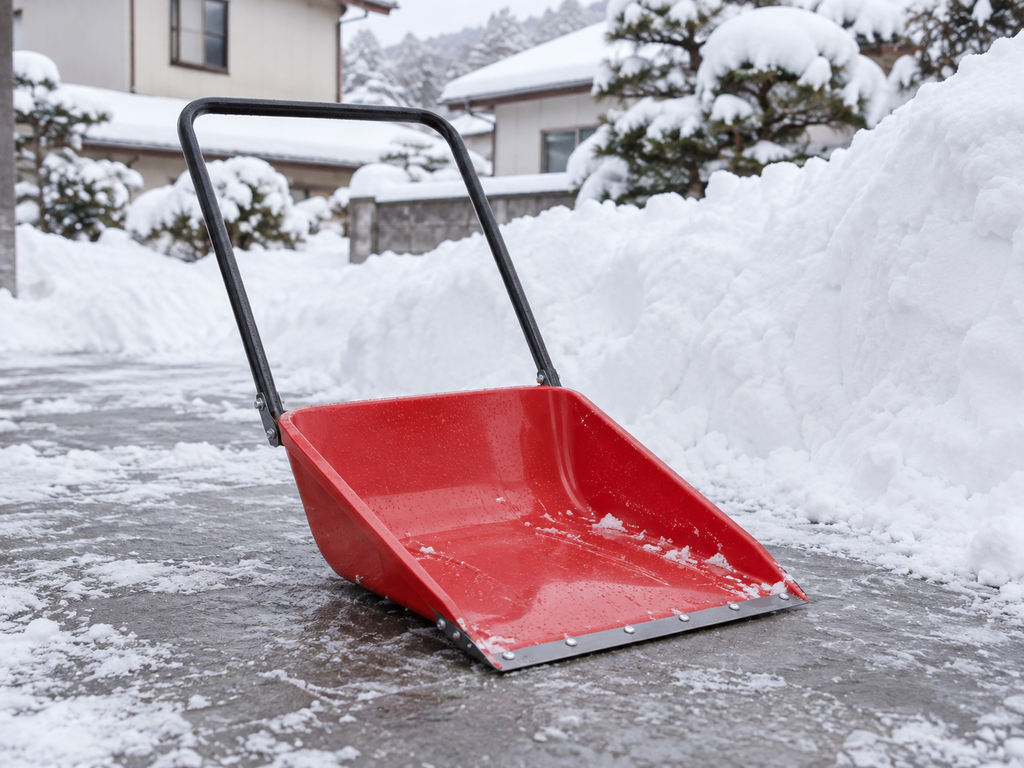
The tray on most household models I have seen is plastic rather than metal.
Some models use stronger plastics or polycarbonate-type materials, and the front edge may be reinforced.
Things I Learned From Actually Using a Snow Dump in Hokkaido
There are a few things about using a snow dump that are easy to overlook if you have never used one before.
These are based on my own experience with snow removal in Hokkaido.
Don’t Overload It With Wet Snow
Wet snow can become extremely heavy.
Because a snow dump has a large tray, it is tempting to fill it as much as possible.
That is not always a good idea.
A fully loaded snow dump filled with wet snow can become very difficult to move, especially when you have to push it uphill.
In that situation, I find it much easier to carry smaller loads several times rather than trying to move everything at once.
The real advantage of a snow dump is not necessarily moving the maximum possible amount of snow.
It is being able to transport snow without repeatedly lifting it.
Leaving a Thin Layer of Snow Can Make It Easier to Slide
This may sound strange, but completely clearing the ground is not always helpful while you are still using the snow dump.
The tray slides very well over packed snow or a frozen surface.
But if you expose bare concrete, friction can increase and the snow dump may become harder to push.
From my experience, when I still have several loads of snow to move, it can be useful to leave a thin layer of snow on the concrete.
That layer acts almost like a sliding surface.
After the heavier snow-moving work is finished, the remaining thin layer can be cleaned up separately.
Be Careful on Gravel
Gravel surfaces require a little more attention.
If you push the snow dump too deeply against the ground, you may scoop up gravel together with the snow.
You might not notice it immediately.
But after carrying several loads to a snow pile, you can end up moving quite a lot of stones away from where they originally belonged.
When spring arrives and the snow melts, those stones may be sitting in your snow-dumping area instead of your driveway.
On gravel, it is usually better not to scrape completely down to the ground.
Leaving a small amount of snow behind can prevent you from carrying your driveway away one load at a time.
Is a Snow Dump Good for Heavy Wet Snow?
Yes, but you have to adjust how you use it.
Light powder and heavy wet snow behave very differently.
A large tray filled with powder may be relatively easy to move.
The same tray filled with wet, dense snow can be surprisingly heavy.
The combination I would particularly avoid is:
Wet snow + a completely full snow dump + an uphill route
Smaller loads are usually much easier.
Different conditions also require different tools.
For example:
- Light powder snow
- Wet heavy snow
- Packed snow
- Frozen snow
do not all behave the same way.
A snow dump is excellent for transporting snow, but it is not the best tool for breaking up hard frozen snow.
That job is usually better handled with another type of shovel or snow-removal tool first.
Can You Buy a Japanese Snow Dump Outside Japan?
The exact snow dumps commonly sold in Hokkaido are not always easy to find overseas.
However, similar tools are available under names such as:
snow scoop
or
snow sled shovel.
If I were comparing them, I would look at:
- Tray width
- Tray depth
- Handle height
- Overall weight
- Tray material
- Reinforced front edge
- How easily the bottom slides
- Suitability for wet snow
- Suitability for powder snow
I also plan to research which Japanese-style snow removal tools can actually be purchased in the United States and other countries.
Is a Snow Dump Better Than a Regular Snow Shovel?
Not necessarily.
They are different tools for different jobs.
A regular shovel is easier to maneuver and works better for:
- Lifting snow
- Breaking up packed snow
- Stairs
- Small spaces
- Detailed cleanup
A snow dump is better when your main problem is:
moving a large amount of snow across the ground.
That is why people in snowy parts of Japan often use more than one kind of snow-removal tool.
There is no single tool that is perfect for every type of snow.
Final Thoughts
The Japanese snow dump is a very simple tool, but it also says something interesting about winter life in snowy parts of Japan.
When snow removal becomes a regular part of everyday life, you start paying attention to things that people in warmer areas may never think about:
the type of snow, the slope of the ground, the surface under the snow, and how far the snow needs to be moved.
A snow dump may look unusual if you have never seen one before.
But when you need to move a lot of snow regularly, the idea behind it is very practical.
In future articles, I plan to look at:
- Other Japanese snow-removal tools
- Japanese vs. North American snow tools
- Which tools work best for different types of snow
- Japanese-style snow tools that can actually be purchased overseas