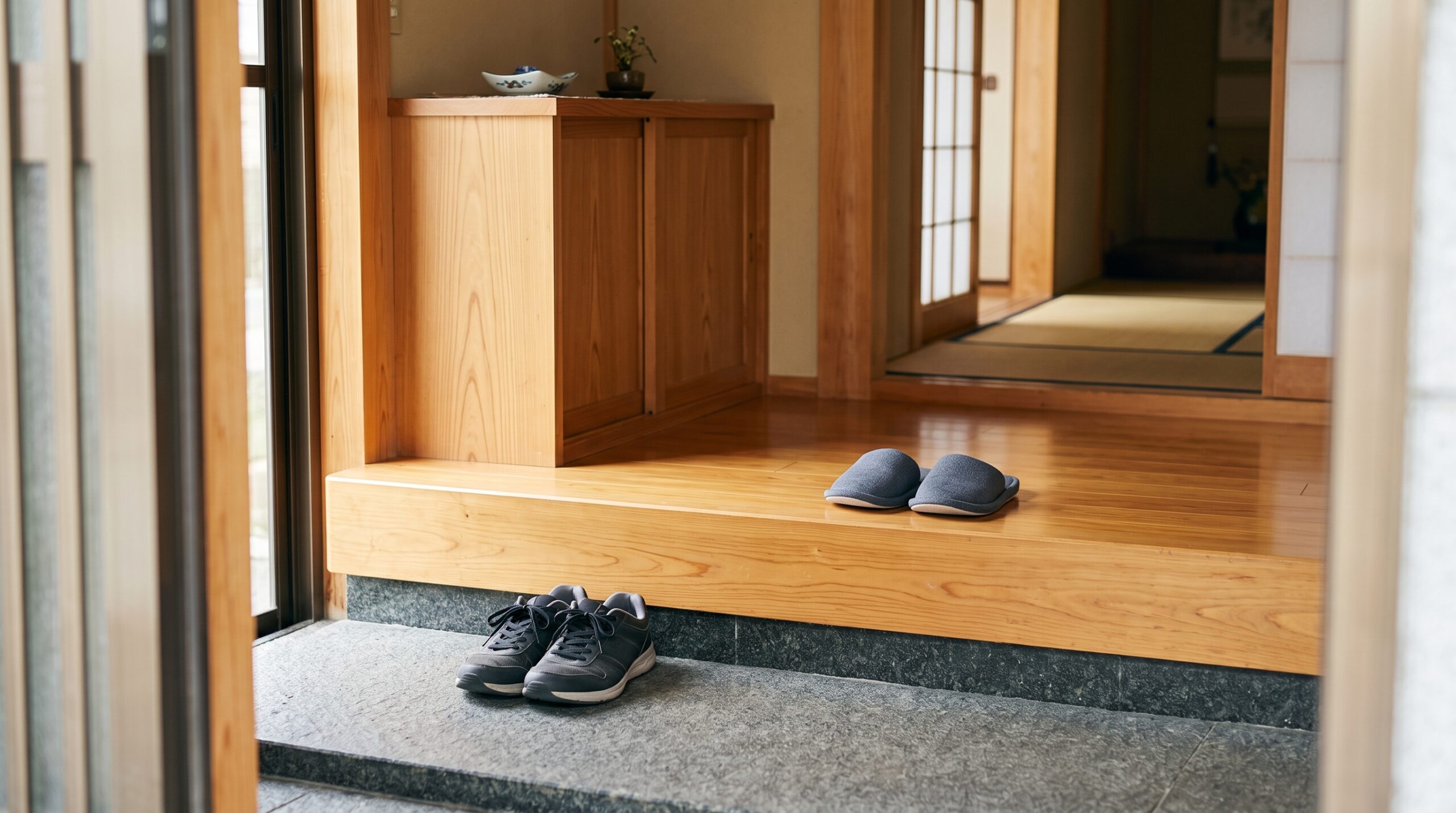
In Japan, you may be asked to take off your outdoor shoes at a home, ryokan, traditional restaurant, temple building, or another space with a shoes-off policy. The easiest rule is to pause at the entrance, look for a sign, shoe rack, or slippers, and follow the staff or host’s instructions. Not every building has the same rule, so do not remove your shoes in a place that clearly expects outdoor footwear to stay on.
Illustrative image: AI-generated depiction of a genkan; entrances and shoe-storage arrangements vary by property.
Quick answer: If a place asks you to remove your shoes, leave them in the designated area, put on indoor slippers if they are provided, and take those slippers off before stepping onto tatami unless the venue says otherwise. Toilet slippers, when present, stay in the toilet area. When you are unsure, ask before crossing the threshold.
The simple rule: follow the floor and the signs
Some Japanese homes and buildings have a genkan—an entrance area where outdoor shoes are removed before entering the main interior. You may notice a lower floor by the door, a step up, shoe shelves or lockers, slippers, or a notice asking visitors to remove shoes. These are helpful cues, but an entrance may not have all of them. A written sign or a staff member’s direction is the clearest guide.
Japan National Tourism Organization (JNTO) guidance describes removing shoes at the entrance and placing them in a shoe box or to the side. It also notes that some attractions, restaurants, and traditional hotels ask visitors to remove shoes. This is not a rule for every shop, restaurant, or hotel: check the specific place rather than guessing from its style.
What to do at a shoes-off entrance
- Pause before stepping inside. Look for a shoe rack, lockers, a change in floor level, slippers, or a sign. If other visitors are removing shoes, that is another clue—but follow posted instructions first.
- Remove outdoor shoes at the entrance. Use the place provided for them. If there is no rack, set them neatly to one side without blocking the doorway or walkway.
- Step into the indoor area in the way the venue indicates. Some entrances have a lower shoe-removal area and a raised interior. Avoid stepping onto a clean interior floor in outdoor shoes. If the boundary is unclear, ask.
- Use indoor slippers only where they are intended. A venue may provide slippers, but you do not have to assume they are for every room. Watch for another change of footwear or a sign.
- When leaving, switch back at the entrance. Return borrowed slippers where indicated, put on your own shoes, and make room for people coming in.
If no shoe rack is provided, place your shoes neatly together and out of the way. Follow any instructions about where to leave them.

If I see slippers by the entrance, should I wear them everywhere inside?

Only where the host or signs indicate. Tatami and toilet areas may have their own footwear rules, so check before walking on.
Slippers, tatami, and toilet slippers
Indoor slippers are often offered after outdoor shoes come off, but the arrangement varies by building. If slippers are provided, use them in the areas they are meant for. Some places ask visitors to remove slippers before entering a tatami-mat room. Leave footwear at the room’s entrance or where a sign shows; do not walk across tatami in outdoor shoes, and do not assume ordinary indoor slippers are allowed on it.
Some restrooms have a separate pair of toilet slippers. If you see them, change into them at the restroom doorway and leave them there when you exit, switching back to your indoor slippers or shoes. Not every restroom provides a separate pair, so do not search for one or borrow footwear from another area.
Some temple buildings require visitors to remove their shoes. Check the entrance instructions: the Japan National Tourism Organization (JNTO) says shoes may be left on shelves or carried in a bag when one is provided. Wear clean socks and follow directions from staff.
Ryokan staff can explain where to change shoes and slippers, and each inn may organize its spaces differently. Follow any signs or instructions in your room and shared areas. For bathhouse entry and bathing steps, see our separate beginner’s guide to onsen and sento.
If you are not sure what to do
Stop before crossing the entrance and ask a staff member or host. You can say:
- ここで靴を脱ぎますか? (Koko de kutsu o nugimasu ka?) — “Should I take my shoes off here?”
- スリッパを使ってもいいですか? (Surippa o tsukatte mo ii desu ka?) — “May I use these slippers?”
Clean, easy-to-remove shoes can make visits to shoes-off places more convenient. If you prefer to wear socks, bringing a clean pair is useful when you expect to visit a home, ryokan, temple building, or tatami room. You do not need to buy special footwear for an ordinary visit.
If you use supportive or medical footwear, or cannot safely remove your shoes, tell staff before entering. Ask whether they can offer an accessible alternative; do not force yourself to follow a custom in a way that could cause a fall or injury.
Frequently asked questions
Do I need to remove my shoes in every Japanese building?
No. Shoe rules vary. Homes, some attractions and restaurants, traditional inns, and certain temple buildings may ask you to remove them. Follow the signs or staff rather than assuming.
Should I remove shoes if I do not see a sign?
Look for a shoe rack, slippers, a clear entrance boundary, or what staff and visitors are doing. If you still cannot tell, ask before stepping further inside.
Can I wear slippers on tatami?
Some venues ask visitors to take slippers off before entering tatami rooms. Follow the host’s or venue’s instructions; do not assume that indoor slippers are permitted there.
What should I do with toilet slippers?
If a separate pair is provided, use it only in the restroom and leave it there when you leave.
A simple way to remember
At an entrance, pause and check the signs, shoe storage, slippers, and floor boundary. Remove outdoor shoes only where the place asks you to; use each pair of slippers only in its intended area; and ask if the next step is unclear. These small checks will help you move comfortably through homes, traditional inns, temples, and other shoes-off spaces without treating one venue’s layout as a rule for all of Japan.
Information checked against Japan National Tourism Organization guidance on September 23, 2026. Shoe and slipper arrangements vary by property and site; current signs and staff instructions take priority.
Sources and further guidance
For general shoe-removal and indoor-slipper guidance, see the Japan National Tourism Organization guide to Japanese manners and etiquette. For situations where shoes may be removed at attractions, restaurants, and traditional hotels, see JNTO’s Japanese customs and etiquette overview. For temple buildings, shoe shelves, and carrying footwear when a bag is supplied, see JNTO’s shrine and temple traditions guide. For ryokan-specific arrangements, see JNTO’s Japanese ryokan guide.
コメント