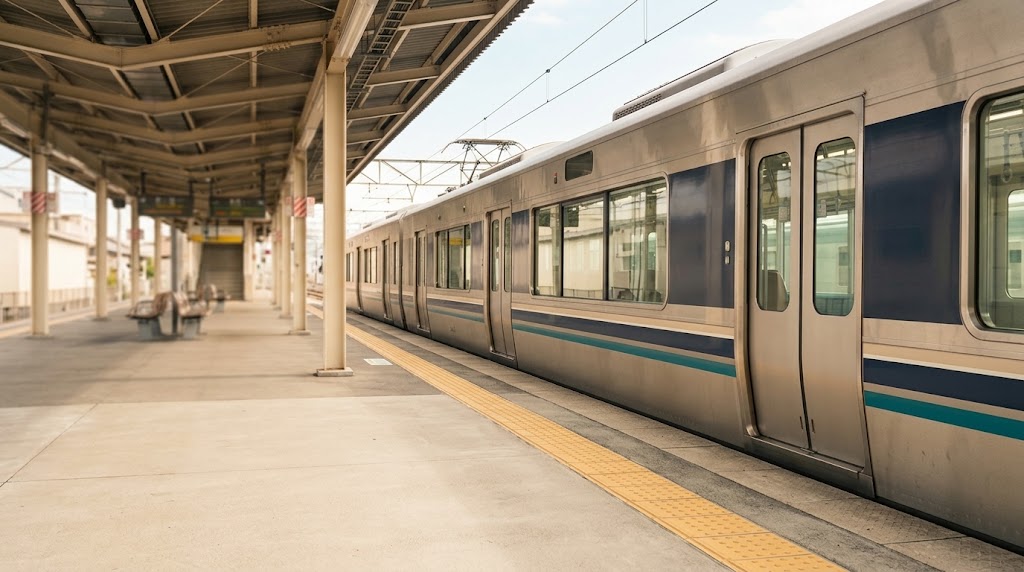
Your first train trip in Japan becomes easier when you break it into five decisions: where to go, how to pay, which gate to use, which train to board, and where to get off. You do not need to understand the entire rail network first.
This guide focuses on ordinary city and suburban journeys. Shinkansen, some airport express trains, and rural services may require different tickets or boarding procedures.
- Your first ride in five steps
- Before your first journey: prepare payment
- Read your route, then match it to the departure board
- Enter the gate and board
- Transfers and through-services: do you need to get off?
- Which trains need extra tickets?
- Leave the station
- If something goes wrong
- Manners that make the ride easier for everyone
- Japanese words to recognize at the station
- Useful Japanese phrases
- Before you set off
Your first ride in five steps
- Save your route. Note the operator, line, direction, departure time, and transfers.
- Prepare payment. Use a transport IC card accepted on your route, or buy the appropriate ticket.
- Enter the gate. Tap your IC card, or insert an ordinary magnetic ticket and collect it on the other side.
- Check the stops. Make sure the approaching train stops at your station. Let passengers off before boarding.
- Exit with the same ticket or IC card. Then follow the signs to the exit nearest your destination.
Before your first journey: prepare payment
Getting and topping up an IC card
Already have a working Suica, PASMO, or ICOCA? Check whether it is accepted on your planned route before buying another card. These are prepaid payment tools, not automatically unlimited-ride passes. Each fare-paying passenger needs an appropriate ticket or IC card of their own.
For a Tokyo-arrival example, physical Welcome Suica is sold at designated Narita Airport stations, Haneda Airport Terminal 3’s Tokyo Monorail station, and selected city counters. Check the official sales list and opening hours first. Other regions offer different local card options; you do not need to obtain a Tokyo-issued card specifically.
For this physical card, use a compatible ticket/fare-adjustment machine or Seven Bank ATM: select charging, place or insert the card as instructed, choose an amount, and pay in yen cash—not by credit card. Collect the card and any change.
Physical Welcome Suica lasts 28 days including purchase day; unused balance is normally non-refundable. Keep its reference paper. These conditions do not describe every IC product. JR East: purchasing and using Welcome Suica
If you prefer a paper ticket
You can make an ordinary journey without an IC card. At the machine, select English where available, then follow its destination or fare-selection instructions. If it asks for a fare, use the operator’s fare chart or station search; do not guess based only on distance. Keep the ticket until your final exit. Tokyo Metro: ticket machines
Other ways to pay
Mobile IC products have device and payment requirements: verify compatibility and set them up before reaching the gate. Some operators also accept contactless bank cards at designated readers. A bank card and a transport IC card are different payment methods; do not assume every IC gate supports both. Tokyo Metro: bank-card travel
Read your route, then match it to the departure board
Set your journey planner to the actual travel date and time. Look for the operator and line, not just the station name: several railways may serve the same station area. Allow extra time for unfamiliar transfers, and check elevator locations if you need step-free access.
Here is a fictional example, not a real timetable:
Your route: A Station → B Station / Example Railway, Blue Line / Local toward C Station / 10:12 / Platform 2.
At the station, find Example Railway’s Blue Line. Check the live board for the 10:12 local toward C and confirm that B is among its stops. If the platform differs from the app, recheck the service details against the current station display before proceeding. Do not take an earlier rapid train unless it also stops at B and your ticket covers it. If you miss the departure, search again rather than assuming the next train follows the same route.
The app’s interface may differ, but the comparison is the same: line → direction → service and time → stopping pattern. JR West explains the information shown on departure boards in its train-use guide.
Enter the gate and board
For IC travel, tap the marked reader and wait for acceptance. Use the same IC card or mobile IC at the destination. Present only the card you intend to use rather than a wallet containing several contactless cards.
For an ordinary magnetic ticket, use a gate with a ticket slot, insert the ticket, and take it back as you enter. QR tickets and rail passes can use different procedures; follow their instructions. JR West: gates and tickets

The board shows a station beyond the one I want. Does that mean this is the wrong train?

That may be its final destination. Look for your station in the stopping pattern; you can get off before the end of the line.
Wait behind the platform safety line, queue where indicated, and let people off first. Do not rush through closing doors. On board, follow the next-stop display or announcements. Tokyo Metro: boarding
Transfers and through-services: do you need to get off?
A transfer means changing trains. A through-service continues onto another line while you remain aboard. A change of line name or operator therefore does not always mean you must get off. Tokyo Metro’s network facts show its through-service connections.
Look for instructions such as “stay on board” or an explicit change of trains in your route. Confirm that they apply to the departure you actually boarded, and follow current announcements. Another train on the same line may terminate earlier or take a different branch.
Remaining aboard does not make the next operator’s section free. A pass limited to one network may not cover that section; check its valid area before travelling.
When changing trains, follow the next line’s signs rather than automatically following “Exit.” Some transfers stay inside the gates; others use a designated transfer gate or a walk outside. Time limits and gate rules vary. Tokyo Metro: transfers
Which trains need extra tickets?
- Local: generally stops at every station along its route.
- Rapid or express: skips some stations; stops and charging rules depend on the operator.
- Limited express: the name alone does not tell you whether your ticket is sufficient.
On JR East, Shinkansen and limited-express journeys require the appropriate express charge as well as the basic fare. Some tickets combine these components. Certain trains are all-reserved, and Green Cars have separate conditions. JR East: ticket types
Other companies differ: Hankyu’s regular limited-express service is available at ordinary fare, while its PRiVACE premium seating requires a separate seat ticket. Hankyu FAQ, PRiVACE
For longer trips, also check IC coverage. A card accepted in two different regions does not necessarily pay for one continuous journey between them. JR East directs travellers crossing separate Suica areas to buy tickets in advance. Some lines are not IC-compatible. An ordinary IC tap is not a Shinkansen reservation, although specific electronic ticket products can be linked to an IC card after setup. Suica coverage, JR East e-tickets
Leave the station
At your destination, tap the same IC again, or insert your ordinary magnetic ticket. A completed single-journey ticket is normally collected; reusable passes are different. Check the exit name or number against your destination before going upstairs. Tokyo Metro: getting off
If something goes wrong
The gate will not open
Step out of the flow of passengers and read the error display. Check that you are using the same card as at entry. If your physical IC was inside a wallet, separate it from other cards. For an insufficient-balance message, use a compatible top-up machine; for an underpaid paper ticket, use fare adjustment or ask staff. If the message is unclear or the problem persists, use the staffed gate or intercom. Do not try to exit on a different IC card: it will not contain this journey’s entry record. JR East: card problems
Wrong train or missed stop
Get off at the next suitable stop and move away from the platform edge. Search again using the station you are now at, your destination, and the current time. Check whether the new route requires another platform or passing through a gate. Ask staff before travelling back if you are unsure about the fare; returning is not automatically free.
Wrong entrance or cancelling a trip
Before leaving, tell staff where you entered and whether you actually rode a train. They can check the entry record and any applicable fare or admission charge. Do not assume repeated taps cancel an entry.
What if I cannot pronounce the station name?
Show the station name on your phone instead. Save it in Japanese as well as English when available, so you can point to exactly where you mean.
Delay or last train
Check current operator information and every remaining connection. The last departure from your station may not get you all the way to your destination. Alternative operators can require another fare; do not assume disruption arrangements cover your ticket. If services have ended, consider a taxi or accommodation rather than expecting overnight trains.
Manners that make the ride easier for everyone
Keep conversations quiet, silence your phone, and avoid calls. Keep bags off seats and out of doors and aisles. Offer seats to people who need them; not every need is visible.
Follow priority-seat and women-only-car notices, including the operator’s conditions and exceptions. Move aside before stopping to check your phone. Never enter the tracks to retrieve an item—tell staff. JR West manners, Tokyo Metro passenger guidance
Japanese words to recognize at the station
- 改札 — kaisatsu — Ticket gates
- 出口 — deguchi — Exit
- 乗り換え — norikae — Transfer
- 各駅停車 — kakueki teisha — Local / all-stations train
- 精算 — seisan — Fare adjustment
- チャージ — chāji — Top up / add balance
These words help you recognize signs and machine menus; their English wording may vary. “Fare adjustment” concerns the fare for your journey, while “top up” adds money to an IC card. Some machines offer both functions.
Useful Japanese phrases
- この電車は〇〇に止まりますか? — Kono densha wa [station] ni tomarimasu ka? — Does this train stop at [station]?
- ここで乗り換えが必要ですか? — Koko de norikae ga hitsuyō desu ka? — Do I need to change trains here?
- 改札を出られません。 — Kaisatsu o deraremasen. — I cannot get through the exit gate.
- このICカードにチャージしたいです。 — Kono ai-shī kādo ni chāji shitai desu. — I’d like to top up this IC card.
Replace 〇〇 / [station] with the station name. You can also show the Japanese sentence to staff. The line over a vowel in the romanization (such as ā) indicates a longer vowel sound.
Before you set off
Save the route, prepare your payment, and allow time to find the platform. For your first ride, focus on matching the line, direction, and stops. Keep the exceptions section handy for special trains or longer journeys, and ask for help before guessing at an unfamiliar gate.
Updated September 26, 2026. New IC-card details and through-service guidance checked against the official sources linked above. Sales locations, service patterns, and ticket conditions can change.

コメント