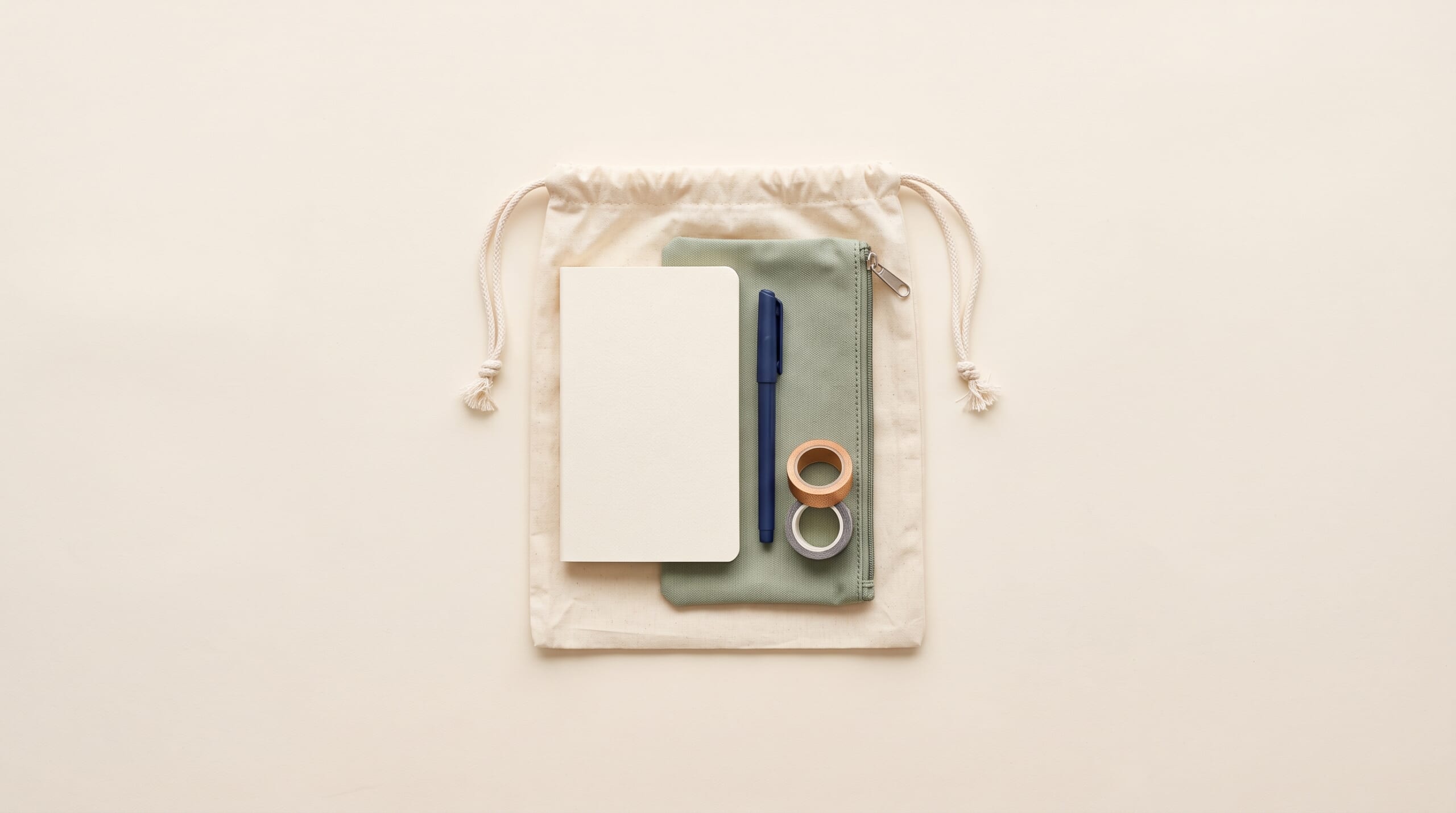
Need a notebook for trip notes, a pouch for loose items, or a small gift that will fit in your suitcase? A 100 yen shop is a useful place to browse during a trip to Japan. A few carefully chosen items can be enough—you do not need to fill a basket.
Despite the name, not every item costs ¥100. This guide helps you choose small gifts and useful travel items, read price labels, and find a shop on your route.
- Quick picks for your trip
- What is a 100 yen shop?
- Does everything cost ¥100?
- Daiso, Seria, and Can Do: where to start
- Stationery and small gifts
- Pouches, bags, and travel organizers
- Everyday essentials and kitchen basics
- What to check on the label
- Finding a store and checking stock
- Useful Japanese at the shop
- Frequently asked questions
- Official sources and review date
Quick picks for your trip
Start with what you need. These ideas give you a short shopping list; the sections below explain how to choose the right size and read the labels.
| Your purpose | Look for |
|---|---|
| Trip notes | A notebook or memo pad |
| Small gifts | Stickers or memo pads |
| Luggage organization | A pouch or drawstring bag |
| Day-bag essentials | A small pack of wet wipes |
What is a 100 yen shop?
A 100 yen shop sells a wide range of inexpensive everyday goods. You may see 100円ショップ on signs, or the shortened name 100均 (hyakkin). Stationery, kitchen items, bags, and other small household goods are useful categories to browse.
JNTO’s budget-travel guide identifies stationery and kitchen utensils among the goods available. A branch on your route can be a convenient place to pick up something you forgot to pack.
Does everything cost ¥100?
No. Some goods cost more, and a price of ¥100 before tax is different from the amount you pay. Look for 税込 (zeikomi), meaning “tax included.” 税抜 (zeinuki) means “before tax.” Do not add tax again to a price already marked 税込.
These examples were listed on official Japanese shop pages when checked on 3 October 2026:
- ¥100 before tax → ¥110 including tax: the varieties shown in DAISO’s drawstring-bag product feature.
- Prices above ¥100: DAISO’s travel collection includes products listed at ¥200 (¥220 including tax) and ¥300 (¥330 including tax).
- A different tax-inclusive food price: DAISO’s snack collection includes products listed at ¥100 (¥108 including tax).
Why ¥110 for goods but ¥108 for some snacks? As of the review date, Japan’s standard consumption tax rate is 10%, while eligible food purchases have an 8% reduced rate. That explains the examples above; the National Tax Agency explains the rates and exceptions. Use the current tax-inclusive label when shopping.
Can★Do’s official product example also shows a series with several prices, including ¥110, ¥220, and ¥330 including tax. Products displayed together do not necessarily cost the same amount.
These are price examples, not a promise of today’s price or stock at the shop you visit. Read the current shelf and package labels. For a multipack, check how many items the displayed price covers.

I found a ¥110 item and a ¥330 item. How much should I budget for both?

If both labels say 税込 and each price covers one item, the two items total ¥440. Add any separately charged shopping bag if you choose one.
Daiso, Seria, and Can Do: where to start
DAISO (ダイソー), Seria (セリア), and Can★Do (キャンドゥ) are names to recognize when searching for a shop. Use their official store pages to find a location that fits your route:
Check the address and opening hours for the branch you plan to visit. If time is short, choose a shop on your existing route and take a short list of what you need.
Stationery and small gifts
Start with notebooks, memo pads, sticky notes, or stickers: small purchases you can use during the trip or bring home as gifts. A notebook can hold your plans and trip notes; stickers or memo pads let you choose a design the recipient will enjoy without taking up much luggage space.
DAISO’s official notebook and memo collection shows different paper sizes and pack quantities. Check whether the pages are lined, plain, or gridded, depending on how you want to use them.
If you enjoy character designs, Can★Do’s official character-goods example includes stationery and pouches at different prices. Some are marked as blind products: the design inside is hidden, and you cannot choose a particular design when buying. Choose a visibly identified design if you want a particular one.
Japanese-style decoration can also be a reason to browse the Japanese-style goods category on DAISO’s official store. Check the individual item’s size and country of origin. A Japanese design does not tell you where the item was made.
Pouches, bags, and travel organizers
Small pouches and drawstring bags can help separate loose items in your luggage. DAISO’s drawstring-bag feature describes uses such as organizing small items and sorting belongings during travel. Its travel collection also lists storage cases and refill containers.
For example, choose a pouch large enough to keep your charging cables and adapters together, so you can find them without searching through your suitcase.
- Measure what needs to fit. Check the opening and usable interior space as well as the outer dimensions of the bag.
- Read the pack quantity. A pack may contain several smaller bags rather than one larger bag.
- Match the container to the contents. Read what a refill container or pouch may hold; do not assume every container accepts every liquid or food.
- Check your packing space. Choose the size you can use now and carry home.
What if a cute zipper bag has a picture of snacks on it?
Check the package instructions before putting food directly inside. Choose a bag labeled for food storage, then check whether freezing or heating is allowed. A cute design does not tell you how the bag can be used.
Everyday essentials and kitchen basics
If you need a small everyday item, check the relevant section before buying a larger pack elsewhere. For example, DAISO’s portable wet-wipe collection lists different pack sizes and alcohol and non-alcohol varieties. Read the intended use and instructions on the specific packet; choose the amount you can actually carry and use.
For a stay with a kitchen, or a small practical gift, DAISO’s official kitchen collection is a source of examples such as utensils, storage containers, and kitchen organizers. Before choosing a container or utensil, check its material, dimensions, and permitted uses.
Do not treat “for the kitchen” as permission to microwave, freeze, or put an item in a dishwasher. Look for the individual instructions. If those uses matter to you and you cannot confirm them, choose a product with clear labeling.
Snacks can be another small purchase where stocked, but compare the quantity as well as the price. The official DAISO snack listings include both single packs and sets of smaller packs. A low package price alone does not establish the lowest price per gram.
What to check on the label
Before taking something to the register, make five quick checks:
- The total price: read the amount marked 税込 and the quantity it covers.
- The size and contents: confirm the dimensions, capacity, number of pieces, or number of sheets.
- The intended use: check what can go inside and how the item may be used or cleaned.
- The material and origin: useful if you need a particular material or want something made in Japan.
- The design: confirm whether you can choose it or whether it is a blind product.
These Japanese labels can help you find the relevant part of a package. The wording varies by product.
- 税込 — tax included
- 商品サイズ / サイズ — product dimensions / size
- 内容量 / 入数 — contents / number of pieces
- 材質 — material
- 原産国 — country of origin
- 使用上の注意 — instructions and precautions for use
A translation app may help you read the text. If an instruction is unclear, show the product to staff and ask before buying it for that use.
Finding a store and checking stock
Online product pages are useful for identifying an item; they do not prove that it is on the shelf at a nearby branch. Can★Do’s official FAQ says the range and quantity vary with a store’s size and location. DAISO’s product features also warn that selection and stock vary by store.
- DAISO: the official DAISO app lets you search stock by product or store. DAISO’s store policy says the information reflects stock as of the previous night, so an item may be unavailable when you arrive. Some stores are outside the service. DAISO does not accept stock checks by phone or hold items for later collection.
- Seria: its official store-page notice asks customers to inspect products in person. It does not accept product inquiries, stock checks, or requests to hold items by phone.
- Can★Do: its official FAQ directs customers to ask staff in person. It does not accept stock checks by phone or inquiry form, and it does not hold products for later collection.
If you cannot install or use the DAISO app, ask staff in person instead. For an item you saw online, save its product name, picture, and JAN code—the product number printed with the barcode—if available. Showing these to staff can make the item easier to identify. Keep an alternative size or design in mind.
Before checking out, confirm the payment methods for the branch. Can★Do’s FAQ says these vary by store. Our guide to paying in Japan explains cash, cards, and ATMs.
Useful Japanese at the shop
Show staff the product or its picture with one of these questions:
- これはどこにありますか?
Kore wa doko ni arimasu ka? — Where can I find this? - これは税込でいくらですか?
Kore wa zeikomi de ikura desu ka? — How much is this including tax?
Frequently asked questions
Are the products all made in Japan?
Do not assume so. If you want an item made in Japan, check 原産国 (“country of origin”) on its label. A Japanese-style design is not a manufacturing-origin label.
Can I count on finding a product shown in a video?
Use it as an idea to look for, not a guaranteed purchase. Store selection varies, and product specifications, prices, and availability can change. Use the chain’s current stock-checking option where available, then confirm the actual item in the shop.
Official sources and review date
Checked on 3 October 2026. This is a general shopping guide based on official information, not a report of visits or product testing. Product specifications, prices, stock, opening hours, and payment options may change. The current product label and branch information take priority.
Featured image: AI-generated generic stationery and bags, created with Gemini. It does not show specific products sold by these shops.
- JNTO: Budget-travel tips and 100 yen shops
- National Tax Agency: Consumption tax rates and reduced-rate eligibility
- DAISO: Drawstring bags, price example, and store-stock note
- DAISO: Travel goods and price examples
- DAISO: Notebooks and memo goods
- DAISO: Japanese-style goods
- DAISO: Portable wet wipes and kitchen goods
- DAISO: Snacks and tax-inclusive price examples
- GS1 Japan: JAN product identifiers and barcodes
- DAISO: App and stock-search FAQ and store policy and stock-data timing
- Seria: Official product-inquiry and stock-checking notice
- Can★Do: Store range, stock inquiries, product holds, and payments
- Can★Do: Character-goods example and blind products and multiple-price example

コメント