Can you travel around Japan without cash? In central Tokyo and other major city centers, many everyday purchases can be made by card or another accepted cashless method. Away from city centers, having cash becomes more important. Bring a usable card and keep some Japanese yen as a backup.
This guide explains how to check payment options, find an ATM for an overseas card, and understand the currency choice on the screen.
- The short answer: plan for both cash and cards
- Which payment method should you use?
- How much cash should you carry?
- Where can you withdraw yen with an overseas card?
- How to use an ATM without guessing
- Japanese yen or your home currency?
- What if your card does not work?
- Where transport IC cards fit in
- Useful Japanese for paying
- Frequently asked questions
- A simple plan before you go
- Official sources and review date
The short answer: plan for both cash and cards
- Before travelling: check your card’s overseas purchase settings. If you plan to withdraw cash, also confirm which card to use, its PIN, withdrawal limits, fees, and the issuer’s contact details.
- Before ordering: look for accepted payment logos or ask the staff. A card accepted at your hotel may not be accepted at the next restaurant.
- Before leaving city centers: check payment methods at your destination and locate an accessible ATM before your cash runs low.
Outside city centers, some ramen shops and long-established restaurants or shops may accept cash only; cash-only businesses also exist in cities. For broader guidance on preparing cash for trips beyond major urban areas, see JNTO’s cashless payment guide.
Which payment method should you use?
| Situation | What to check |
|---|---|
| Hotel, department store, or larger shop | Check the accepted card brands. Do not assume every overseas card works. |
| Small restaurant or local business | Look for a cash-only notice or accepted payment logos at the entrance, counter, or ticket machine. |
| Ticket machine, vending machine, or locker | Read that machine’s payment symbols and accepted cash denominations. |
| A terminal you can tap | Check whether it accepts your bank card, transport IC card, or phone payment service. |
JNTO’s credit card guide explains that international cards can be used at participating businesses.

If I see a reader for tapping, should I just hold my phone over it?

Tell the cashier which payment method you want to use first. “Credit card” and “Suica” are different options, even when you use the same phone.
How much cash should you carry?
There is no single amount that suits every trip. A city day with prepaid accommodation is different from a rural stay where meals, transport, and lodging need cash.
Work out the cash-only expenses you expect before your next reliable ATM stop, then add a buffer for changes. Check your accommodation and activities directly.
A calculation example, not a price guide: if your own planned cash-only expenses total ¥4,000 and you choose a ¥2,000 buffer, you would prepare ¥6,000 before the next ATM stop. These are hypothetical figures, not a recommended daily amount. Replace them with the costs you have checked for your trip.
Keep some smaller notes and coins for machines that cannot accept every denomination. Check the labels rather than assuming a large note will work. Carrying all your trip money at once is not necessary if you have confirmed access to cash along your route.
Where can you withdraw yen with an overseas card?
Two options to check are Seven Bank ATMs and Japan Post Bank ATMs. Their official pages list supported card networks and service conditions. Seven Bank also links to an ATM search. Look for its ATMs in 7-Eleven stores, airports, and stations; Japan Post Bank ATMs can be found at post offices and other locations. Confirm the individual location before going.
Check the logo on your card against the ATM’s supported networks. A matching logo does not guarantee that your particular card will work. Location access, service hours, maintenance, and your issuer’s restrictions can affect use.
Bring the physical card and know its correct PIN. Check both the ATM’s displayed fee and your issuer’s overseas withdrawal charges. Their limits can differ, too.
A credit card withdrawal may be a cash advance, with fees and interest that differ from ordinary purchases. Check your issuer’s terms before relying on it. Chase’s explanation of cash advances illustrates why the ATM fee alone may not be the full cost.
How to use an ATM without guessing
- Insert your physical card when prompted, then select a supported language and the withdrawal option. Follow the machine’s instructions.
- If asked to select an account, choose the one your issuer says to use for that card.
- Enter the correct PIN privately, and choose the amount in Japanese yen.
- Review fees and any currency-conversion choice before confirming.
- Collect your cash, card, and receipt. Check that the transaction is finished before leaving.
The order and wording vary. Seven Bank’s illustrated Visa-card instructions show one example; do not expect every ATM screen to look identical.
Japanese yen or your home currency?
An ATM or card terminal may offer dynamic currency conversion (DCC): the provider converts the transaction into your home currency using its offered rate and charges.
Choosing JPY / Japanese yen instead leaves any required conversion to your card network or issuer under your card’s terms. This avoids accepting the ATM or merchant’s conversion offer; it does not mean there are no fees, or guarantee the lowest total cost for every card.
On the screen: if you want the transaction charged in yen, select the JPY option or the option to proceed without the provider’s conversion, as shown on that screen. Declining the conversion offer does not itself cancel the purchase or withdrawal. Button labels vary, so distinguish the currency choice from cancelling the whole transaction.
Read the amounts, rate, and markup before deciding. Visa says you should have a choice, and recommends declining the conversion if the required information is missing or you feel pressured. See Visa’s DCC guidance.
If the ATM offers dollars, does that mean it will give me dollar notes?
At the yen-withdrawal ATMs described here, that choice is about billing. You still receive yen. Check the yen withdrawal amount before confirming.
What if your card does not work?
- At a shop: ask whether that card brand and payment method are accepted. If supported, ask staff whether inserting the physical card is an option. Use another accepted method if needed.
- At an ATM: read the error. If the requested amount exceeds the per-transaction limit, a smaller amount may help. If you have used up your issuer’s daily allowance, splitting the request will not create more allowance; ask the issuer when it resets or what options are available.
- For a PIN error: do not keep guessing; contact your issuer.
- If the reason is unclear: check the issuer’s app or contact its support. A card can work for shopping but be restricted for overseas cash withdrawals.
- If cash was not received but a debit appears: keep the receipt or transaction details, record the ATM location and time, and contact the ATM operator and your issuer. Avoid repeatedly making the same request while the result is unclear.
If an ATM keeps your card, use the operator’s contact details shown on the machine and contact your issuer. Do not give your PIN to someone offering to help.
Both the ATM’s limit and your issuer’s limit apply. Chase explains per-transaction and daily withdrawal limits; your own issuer’s rules determine your card’s allowance.
Keep a backup payment method separately where practical, and do not wait until you have no cash left to test your card.
Where transport IC cards fit in
A transport IC card such as Suica can cover eligible transport and purchases at participating shops (JR East FAQ, Japanese). It is not a replacement for every bank-card payment or a way to withdraw cash from your bank account.
Top-up methods differ between physical cards, mobile services, and specific products. Do not assume your overseas credit card can recharge every version. Follow the instructions for the card you actually have. Seven Bank describes cash top-ups for supported IC cards; JR East lists Suica top-up methods (Japanese).
For stations, tickets, and IC-card travel basics, see our guide to riding trains in Japan.
Useful Japanese for paying
- カードは使えますか?
Kādo wa tsukaemasu ka? — Can I pay by card? - 現金のみ
Genkin nomi — Cash only. - ATMはどこですか?
Ē tī emu wa doko desu ka? — Where is an ATM? - 日本円でお願いします。
Nihon-en de onegai shimasu. — Please charge me in Japanese yen. - カードが使えません。
Kādo ga tsukaemasen. — My card is not working.
You can show these phrases on your phone. When asking about a card, showing its brand can make your question clearer.
Frequently asked questions
Can I rely on my phone alone?
It is safer to have a backup. Your phone needs a supported payment setup, and the business must accept that method. A physical card and some yen also help if your phone loses power.
Does every convenience store have a suitable ATM?
Do not assume so. Confirm the actual ATM operator, card support, and access hours. A store’s opening hours and a card’s available service hours are not necessarily the same.
Should I withdraw money or exchange cash?
Compare the complete costs for your circumstances: your card’s terms, ATM charges, or the exchange counter’s rate and fees. If using an exchange counter, check its accepted currencies and opening hours before depending on it. Neither option is automatically cheapest for everyone.
A simple plan before you go
Confirm your card and PIN, check known cash-only expenses, and locate an ATM along your route. At checkout, confirm the accepted method; at an ATM, read the fees and currency choice. A little preparation leaves more time for the trip itself.
Official sources and review date
Checked on 1 October 2026. Acceptance, fees, limits, and service hours may change. Follow the current information from the business, ATM operator, and your card issuer.
- JNTO: Cashless payments in Japan
- JNTO: Credit cards in Japan
- Seven Bank: Overseas cards, ATM instructions, and cash IC top-ups
- Japan Post Bank: International ATM service
- Visa: Dynamic currency conversion
- Chase: How credit card cash advances work
- Chase: ATM withdrawal limits
- JR East: Shops accepting Suica (Japanese)
- JR East: Suica top-up methods (Japanese)
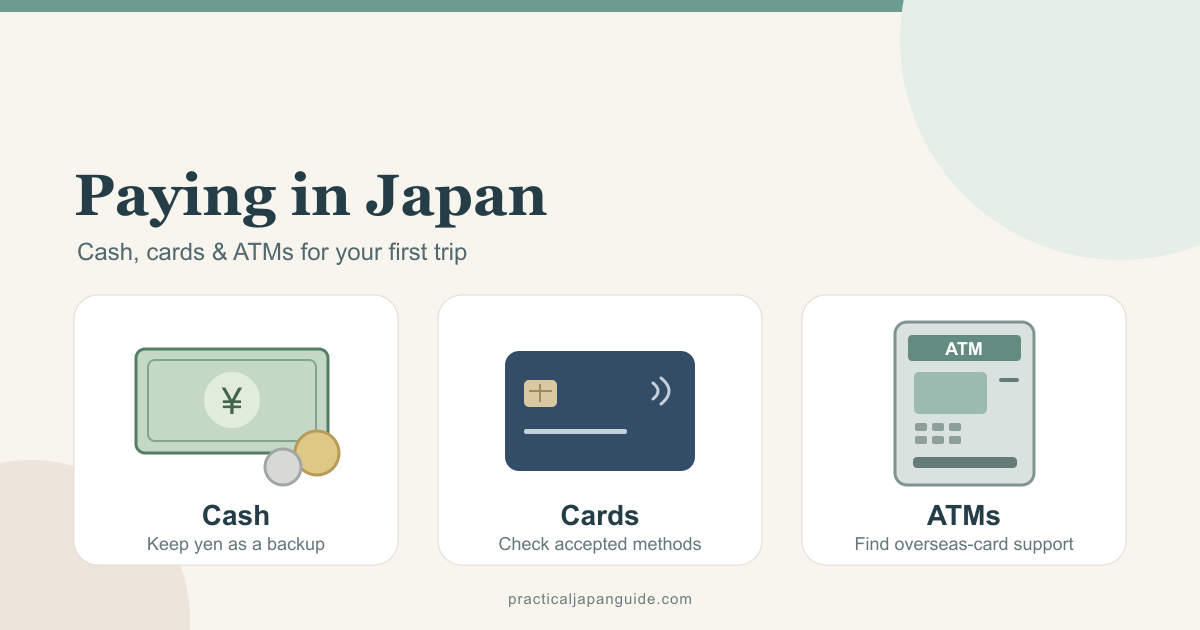
Featured image: original illustration by Practical Japan Guide. The symbols are illustrative; they do not represent a particular banknote, card brand, or ATM screen.
コメント