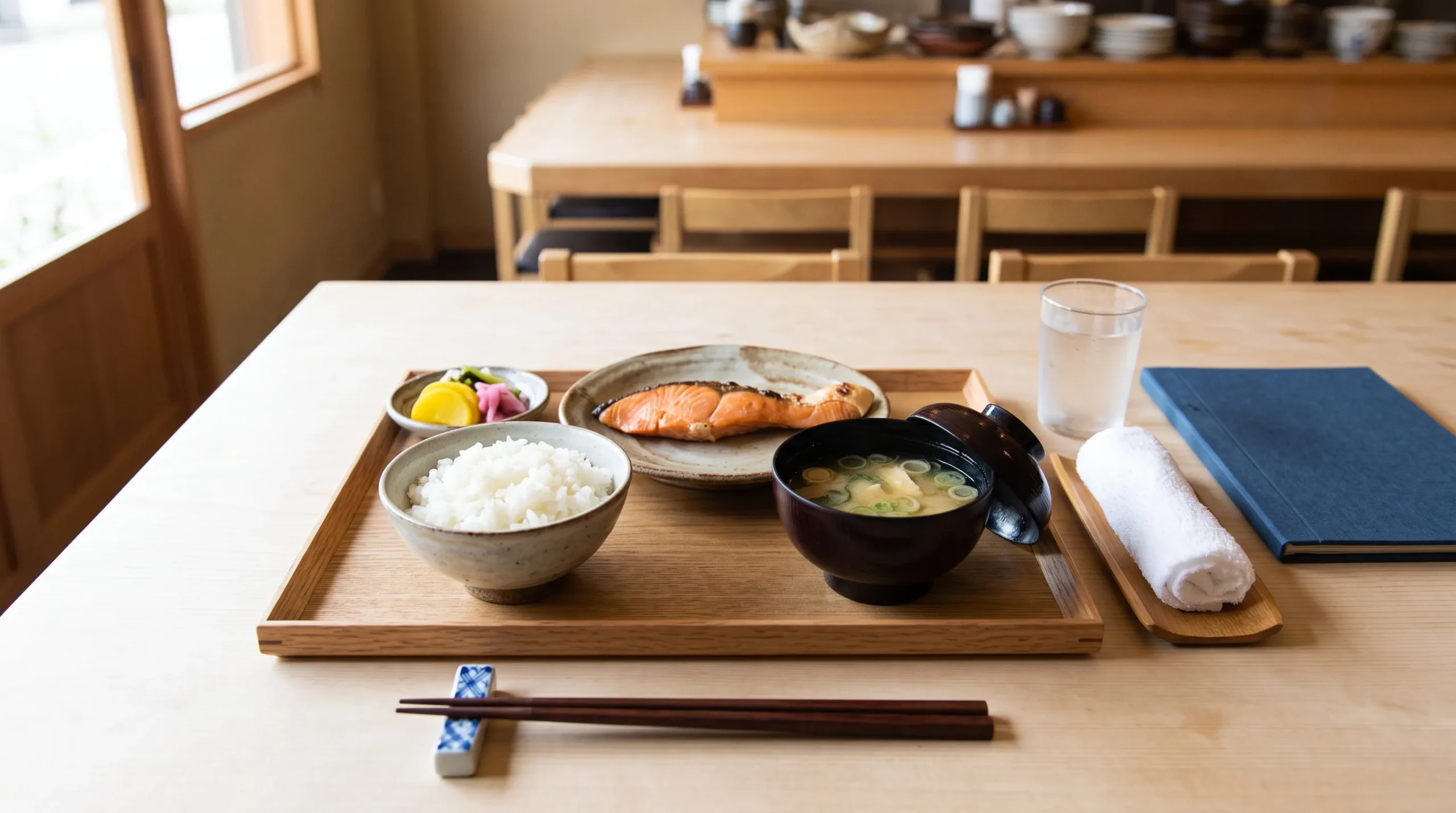
A steaming bowl of ramen or a freshly grilled fish set meal can be a highlight of a trip to Japan. The unfamiliar part is often the routine: should you sit down, buy a ticket, call someone, or take the bill to the register?
This guide follows a restaurant visit from the entrance to the final thank-you. There is no single system used everywhere: follow the restaurant’s signs and staff instructions.
- The three ordering patterns to recognize
- Before you go: check what matters to you
- At the entrance: follow the seating instructions
- How to place your order
- Otoshi and other extra charges
- Enjoy the meal without overthinking the rules
- Paying and leaving
- Useful Japanese: show these on your phone
- Frequently asked questions
- A simple routine for your first meal
- Official sources and review date
The three ordering patterns to recognize
- Order at your table: get seated, check accepted payment methods, choose from the menu, then order through staff, a tablet, or your phone.
- Buy a meal ticket: select and pay at a machine, then follow the instructions for submitting the ticket or collecting your meal.
- Order at a counter: follow the displayed ordering, payment, and collection instructions.
Knowing which pattern the restaurant uses is more useful than memorizing one sequence for every meal.
Before you go: check what matters to you
Check the restaurant’s current hours, reservation policy, menu, and accepted payments. For a booked meal, read the cancellation terms and contact the restaurant promptly if your plans change. If there are minimum orders or dining time limits, confirm those too.
Food allergies
Explain your allergies when booking and again on arrival, before any food is served. Check your chosen meal before ordering or buying a ticket, and name every ingredient you need to avoid. Ask a staff member who can check the ingredients and preparation, including possible cross-contact: unintended allergen transfer from shared utensils, equipment, or preparation areas.
Menu photos and translations cannot establish allergy safety. If the information you need cannot be confirmed, or concerns remain, choose another restaurant rather than guessing. See Nagoya City’s official allergy guidance (Japanese).
The Consumer Affairs Agency provides an English-version food-allergy communication sheet (PDF). Download and prepare it before your trip; the agency notes that the checkboxes do not work unless the PDF is downloaded. Show the completed sheet to staff.
Vegetarian, vegan, or other dietary requirements
Explain the ingredients and preparation you need to avoid, rather than relying on a label alone. A vegetable or tofu dish may still use fish-based stock, meat extracts, or animal-based sauces. For vegan meals, confirm eggs and dairy too. Ask ahead, especially for a set menu; changes may not be possible. See JNTO’s vegetarian and vegan guidance.
At the entrance: follow the seating instructions
Unless signs or staff direct you to seat yourself, buy a ticket, or join an ordering queue first, pause near the entrance and wait for staff. Tell them your party size and, if booked, your reservation name. An empty table does not necessarily mean it is available.
If there is a queue, sign-in sheet, or numbered check-in system, follow that system. At a shoes-off entrance or tatami seating area, follow the signs; keep shoes and slippers off the tatami.
These are common patterns described by GO TOKYO’s restaurant guide. For a genuine exception, ICHIRAN’s system guide explains choosing an available booth using its seat display. Always use the instructions at the branch you visit.
How to place your order
If staff take the order
In many casual restaurants in Japan, politely calling staff with すみません / Sumimasen (“Excuse me”) is a normal, acceptable way to get their attention. Here, it is a request for attention, not an apology for a mistake.
Choose your items first. Use a table bell or call button if provided; otherwise say “Sumimasen” clearly and politely at a volume nearby staff can hear. Once they acknowledge you, give them time to come over. At a ramen shop that takes spoken orders, you can call staff this way too.
When staff come over, point to the menu and say これをお願いします / Kore o onegai shimasu (“I’d like this, please”). Confirm the quantity. Visit Kinosaki, Toyooka City’s official tourism site, explains calling staff with “Sumimasen” or a table bell.
If you order on a tablet or your phone
Some restaurants provide a tablet; others use an ordering QR code that you scan with your own phone. For QR ordering, use the code provided for your table and follow the ordering screen’s instructions.
Use a language option if available. Check the items, quantities, and total, submit the order, and look for confirmation. If you are unsure whether it went through, ask staff before sending it again. Completing an order does not necessarily pay the bill. Check that restaurant’s payment instructions.
If you cannot use your phone or the page will not load, ask staff how you can order. For example, Saizeriya’s official guide describes QR ordering and also allows spoken orders after calling staff with the table bell. Other restaurants may offer different alternatives. GO TOKYO explains tablet ordering; English menus and language options are not universal.
If there is a meal-ticket machine
A meal ticket records the food you selected and paid for at the machine. The ticket or numbered slip is then used as the restaurant directs.
- Read the menu and instructions. Check whether you should buy before joining the seating queue, and whether your payment method is accepted.
- Select and pay as directed. Some machines ask you to insert cash before selecting an item; others have a checkout step after selection. Ask for help if you are unsure.
- Collect what is issued. Take the tickets or numbered slip and any change. Keep it until you hand it to staff or use it to collect your meal.
- Follow the handover or collection instructions. Staff may take your ticket, or the order may be sent automatically and collected when your number is called or shown as ready.
For example, ICHIRAN explains handing tickets and an order sheet to staff, while Matsuya’s self-service instructions describe automatic ordering and numbered collection. These are examples of different systems, not instructions for every branch. ICHIRAN’s FAQ also confirms that cashless ticket machines exist; a meal-ticket machine does not automatically mean cash only.
If you order at a service counter
Join the indicated ordering queue and check when to pay and where to collect your food. An ordering counter is a service point; a counter seat is simply a place to sit and does not by itself tell you how to order.
For example, Marugame Seimen’s official guide shows ordering and receiving udon, choosing extra items such as tempura or rice balls, paying at the register, and getting condiments or water before taking a seat. This is one example: the sequence and collection method can differ, so follow the instructions at the restaurant you visit.

What if I buy the wrong meal ticket or accidentally send the same order twice?

Show staff the ticket or order screen and explain the mistake right away. Before buying another ticket or submitting another order, ask whether they can correct or cancel it. If you have already paid, ask whether a refund is possible.
Otoshi and other extra charges
At some izakaya—Japanese-style pubs—a small appetizer called otoshi (お通し) is brought without a separate order and forms part of a per-person cover or seating charge. Do not assume it is complimentary. JNTO’s nightlife guide explains this custom.
Some establishments also apply a service charge, as noted by GO TOKYO’s money guide. Otoshi, seating, and service charges are not three automatic additions everywhere: names and arrangements differ.
Before ordering, ask what extra charges apply, their amounts, and whether they are per person. If you do not want or cannot eat the otoshi, explain this early and ask whether you can decline the dish and whether the charge still applies.
What if the otoshi arrives before I have explained a food allergy?
Leave it untouched and ask staff to check it. Tell them exactly what you must avoid; an automatically served dish still needs the same ingredient and preparation checks.
Enjoy the meal without overthinking the rules
- Water and towels: water provided on seating is commonly free, but a drink ordered from the menu may be charged. Water may be self-service. Use an oshibori—the wet towel—for your hands.
- Chopsticks: do not stand them upright in rice or pass food directly from your chopsticks to another person’s. Use serving utensils for shared food and place your portion on a small plate.
- Noodles: slurping is accepted for ramen, soba, and udon, but you do not have to do it.
- If chopsticks are difficult: ask for a fork or spoon; the restaurant may not have an alternative.
- Portions: start with an amount you expect to finish. Check the restaurant’s policy before sharing an order, bringing outside food, or taking leftovers away.
These basics are covered in GO TOKYO’s dining customs, JNTO’s food-etiquette guide, and JNTO’s customs guide. At a self-service restaurant, return dishes to the marked return area if instructed.
Paying and leaving
For a meal paid in advance, you do not pay for the same items again; follow the instructions for any additional orders. Otherwise, ask for the bill when ready. If staff direct you to the register, take the table’s bill or payment slip there. At your table, follow any tablet or mobile-payment instructions; if staff handle payment, ask them and wait. Some restaurants use a self-checkout; follow its instructions or ask for help.
Ask 別々に払えますか? / Betsubetsu ni haraemasu ka? (“Can we pay separately?”) before assuming the restaurant can split the bill. If it cannot, arrange one payment within your group.
Tipping is not customary at ordinary restaurants in Japan. Pay the bill, including applicable charges, and thank the staff. See JNTO’s tipping guidance.
Payment methods vary: check before ordering and keep some yen available. For overseas cards, ATMs, and currency choices, see our guide to paying in Japan. For an example of table payment, Skylark describes payment through its digital menu system (Japanese PDF). The Tokyo Metropolitan Government’s dining handbook (pages 11–13) also explains payment locations and self-service routines.
Useful Japanese: show these on your phone
You can point to the Japanese text. These phrases help you ask a question; staff still need to confirm the answer.
- 2人です。
Futari desu. — There are two of us. - 英語のメニューはありますか?
Eigo no menyū wa arimasu ka? — Do you have an English menu? - すみません。
Sumimasen. — Excuse me. - これを1つお願いします。
Kore o hitotsu onegai shimasu. — One of these, please. - お通し代・席料・サービス料はかかりますか?
Otōshi-dai, sekiryō, sābisu-ryō wa kakarimasu ka? — Are there otoshi, seating, or service charges? - 私は○○のアレルギーがあります。
Watashi wa ○○ no arerugī ga arimasu. — I have an allergy to ○○. Replace ○○ with the ingredient; also show your detailed allergy card. - 注文を間違えました。
Chūmon o machigaemashita. — I made a mistake with my order. - お会計をお願いします。
Okaikei o onegai shimasu. — The bill, please. - カードは使えますか?
Kādo wa tsukaemasu ka? — Can I pay by card? - ごちそうさまでした。
Gochisōsama deshita. — Thank you for the meal.
JNTO’s language guide explains common expressions such as “Sumimasen.”
Frequently asked questions
Can I eat out without speaking Japanese?
Photo menus, pointing, and written phrases can help. Do not assume staff speak English, and allow time to clarify your order. For allergy or dietary questions, choose a restaurant that can confirm the information you need.
Is an otoshi charge a tourist-only fee?
The otoshi custom is described in official visitor guides as part of izakaya dining, not a tourist-only practice. Ask about the actual charge and what it includes before ordering.
Do I have to say “itadakimasu”?
No. It is a customary expression of appreciation before eating, rather than a requirement for visitors. A polite thank-you after the meal is welcome. JNTO’s FAQ explains these meal expressions.
A simple routine for your first meal
Check the menu and any essential requirements, follow the seating instructions, identify how to order, and ask about any extra charges before placing an order or buying a meal ticket. Then enjoy the food. When it is time to leave, follow that restaurant’s payment or dish-return instructions and offer a thank-you.
Official sources and review date
Checked on 3 October 2026. This is a general guide, not a report of visits to the restaurants named. Ordering systems, charges, menus, and payment options may change; the current restaurant’s instructions take priority.
- GO TOKYO Gourmet: Restaurant entry, seating, and ordering
- Tokyo Metropolitan Government: How to Enjoy Tokyo, dining section (PDF)
- ICHIRAN: System guide and payment FAQ
- Matsuya: Self-service ordering instructions (PDF)
- Skylark: Digital-menu table payment (Japanese PDF)
- JNTO: Izakaya and cover charges
- GO TOKYO: Money and service charges
- GO TOKYO: Dining customs and dietary requirements
- JNTO: Food etiquette, customs, and tipping
- JNTO: Vegetarian and vegan guide
- Nagoya City: Food allergies and dining out (Japanese)
- Consumer Affairs Agency: Allergy communication sheet (English PDF) and usage instructions
- JNTO: Japanese expressions and visitor FAQ
- Visit Kinosaki: Calling restaurant staff and using a table bell
- Saizeriya: QR ordering and spoken-order alternative (Japanese)
- Marugame Seimen: Counter ordering, payment, and seating (Japanese)
Featured image: AI-generated with Gemini for Practical Japan Guide. It illustrates a Japanese set meal and does not show a specific restaurant.

コメント