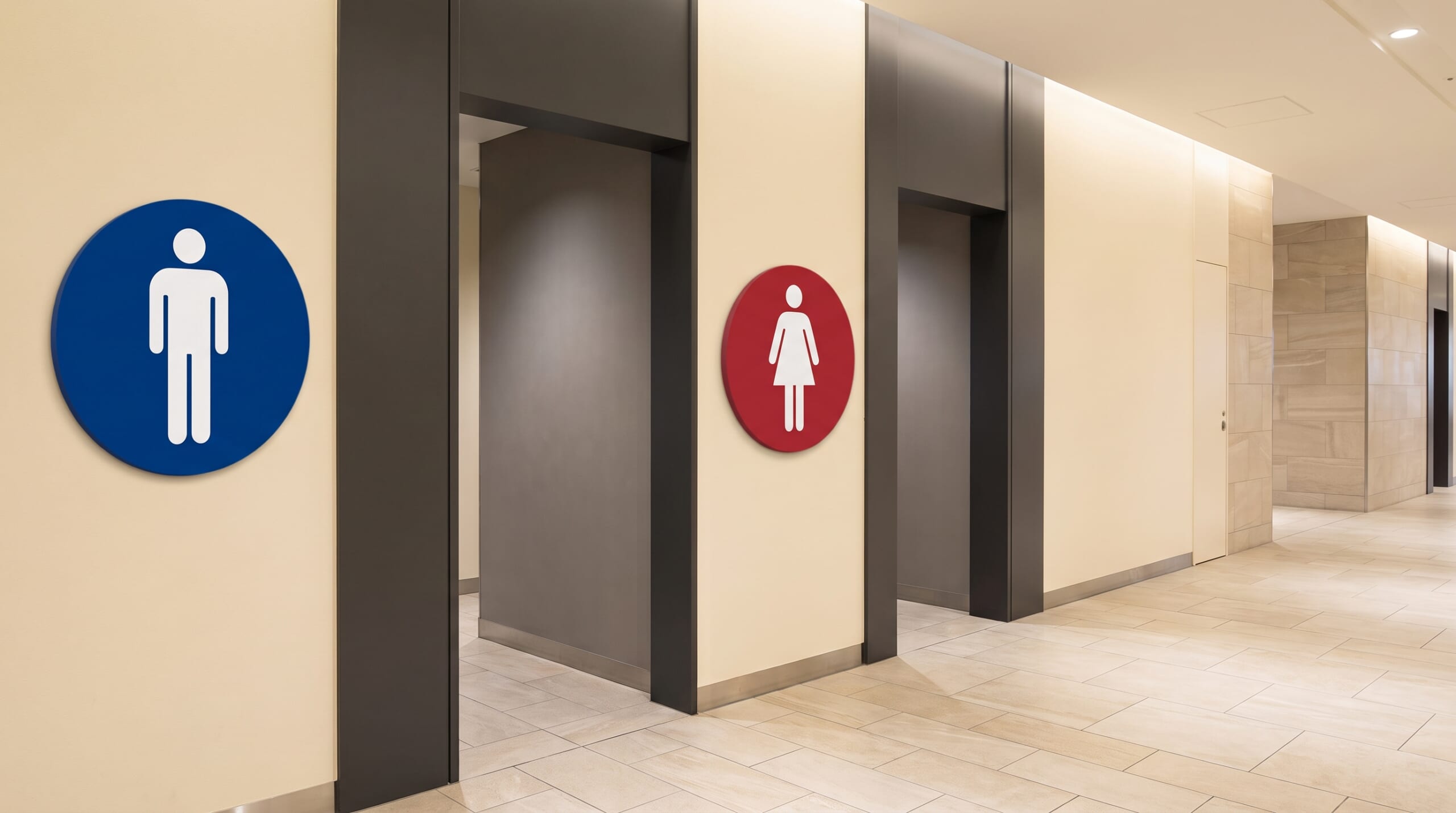
While sightseeing in Japan, you may need to find a nearby restroom or work out which Japanese button flushes the toilet. This guide focuses on those practical questions: where to look, what the controls mean, and where used toilet paper belongs.
You do not need to use the bidet spray. If you are comfortable with an ordinary seated toilet, the main thing to identify is the flush control. Equipment and access rules vary, so follow the instructions at the facility you visit.
- Need a restroom now? Start here
- Where to find public toilets in Japan
- Finding the flush control
- Japanese toilet buttons: a quick guide
- Toilet paper goes in the bowl; other waste does not
- What if the cubicle has a squat toilet?
- Useful Japanese for finding a toilet or asking for help
- Two other practical questions
- A few checks make the next stop easier
- Sources and image note
Need a restroom now? Start here
Look for トイレ or お手洗い, both meaning toilet or restroom. Follow the pictograms and direction signs. If you cannot find one, ask staff: トイレはどこですか? (Toire wa doko desu ka? — “Where is the restroom?”).
Start with a facility you are already visiting: a station, shopping centre, department store, or tourist facility. The table below explains what to check before using it.
Where to find public toilets in Japan
JNTO describes free public restrooms in stations and other venues. Many are free to use, but access to the building or station area may have separate conditions. Equipment, opening hours, and cleanliness vary.
| Place | What to check |
|---|---|
| Train stations | Follow restroom signs or the station map. A toilet may be inside the ticket gates. Ask station staff before entering a paid area just to use it. |
| Shopping centres and department stores | Check the floor guide for restroom symbols. Use them during opening hours and follow the facility’s access rules. |
| Parks and tourist facilities | Look for public-toilet signs or ask at a visitor information desk. Check whether the facility is open and whether admission is needed. |
| Convenience stores, cafés, and restaurants | Ask staff whether you may use the toilet. Some do not provide visitor toilets; others restrict use to customers. |
If you use a map app, search for “public toilet” or “トイレ”, then confirm access when you arrive. A map listing does not guarantee that the restroom is currently open or outside a paid area.
In Tokyo’s Shibuya area, THE TOKYO TOILET’s official website lists its public-restroom locations and individual facilities. It covers that project, not every toilet in Tokyo or Japan.
A local tip: allow extra time in busy city centres
From my experience: on visits to busy city centres such as Tokyo, I have often come across convenience stores without customer toilets and found shop restrooms already in use. This is a personal observation; availability varies by store and time of day.
If you will need a restroom soon, use an available one before moving on, rather than relying on the next convenience store. Allow extra time to find one and wait if necessary, instead of leaving it until it is urgent.
If you need an accessible toilet or changing facilities
Look at the facility symbols for wheelchair access, a baby-changing table, or other equipment you need, and ask staff if the route is unclear. A wheelchair symbol does not tell you every detail about the room or its equipment.
Give priority to people who need an accessible toilet’s space or equipment, including needs that may not be visible. Do not use it simply to avoid a queue when you can use an ordinary cubicle. Japan’s transport ministry explains why considerate use matters (Japanese).
Finding the flush control
Look for a lever, a button marked 流す or FLUSH, or a clearly marked flush sensor. Controls may be on the wall, beside the seat, or on the toilet itself. Follow the label or diagram rather than waving at an unmarked device.
Some toilets flush automatically, but check the bowl before leaving and use the marked control if needed. If it is blocked or will not flush, tell staff rather than repeatedly flushing. TOTO’s English operating sheet (PDF) illustrates separate washing, stopping, and flushing controls; the exact functions differ by model.
I pressed a button and heard water, but nothing moved in the bowl. Did I flush it?
If it was 音 or 音姫, that was a privacy sound, not a flush. Find 流す, FLUSH, or the flush lever, and check the bowl afterward.
Japanese toilet buttons: a quick guide
TOTO’s visitor guide distinguishes rear cleansing, front cleansing, stopping, flushing, drying, and privacy sounds. WASHLET is TOTO’s brand name; other makers also offer electronic bidet seats. Not every toilet has all the functions below, and the layout and wording can differ.
| Label and reading | English meaning |
|---|---|
| 流す nagasu | Flush the toilet bowl. |
| 大 / 小 dai / shō | Full / light flush. Generally, full is for solid waste and light is for urine. Follow the instructions on that toilet, including any guidance about flushing toilet paper. |
| 止 / 停止 tome / teishi | Stop the bidet spray or dryer. This is not the flush button. |
| おしり oshiri | Rear wash: an optional water spray for washing your bottom after using the toilet. |
| ビデ bide | Front wash: an optional spray for washing the external female genital area (feminine cleansing). |
| 乾燥 kansō | Warm-air drying, if fitted. |
| 音 / 音姫 oto / otohime | Privacy sound. It does not flush the bowl. |
Do not confuse a button or cord marked 呼出 (call for assistance) or 非常 (emergency) with a flush control. These may be emergency calls: use them for urgent assistance according to the posted instructions, not for routine questions about buttons or missing paper. For those questions, ask staff outside the cubicle. The Japan Sanitary Equipment Industry Association explains the distinction (Japanese).
Trying the water spray is optional
If you want to try it, find STOP before starting and remain seated throughout. Follow the posted washing instructions, select rear or front wash as appropriate, and use gentle pressure if it is adjustable. Press STOP before standing up. Dry with toilet paper, or use the dryer if one is provided.
The spray cleans your body; it does not flush the bowl or replace handwashing. You can skip it and use toilet paper. If controls are unclear or a function does not work, use the ordinary toilet functions or ask staff; you do not need to experiment with every button.
Toilet paper goes in the bowl; other waste does not
There is a little bin in this cubicle. Should used toilet paper go there?
In an ordinary flush toilet in Japan, used toilet paper goes into the bowl and is flushed. That bin may be for sanitary products—check its label rather than treating it as a bin for everything.
This matches GO TOKYO’s toilet etiquette guidance. Follow special instructions if you encounter a nonstandard toilet, such as a portable or non-flush system.
Ordinary tissues, wipes, sanitary products, diapers (nappies), and packaging do not belong in the bowl. TOTO’s blockage-prevention notice (PDF) specifically distinguishes toilet paper from tissues and other objects. Use the appropriate marked waste bin; if there is none, keep non-flushable items contained and ask staff about disposal. Do not assume that a wipe can be flushed just because its packet says “flushable.”
If there is no toilet paper, try another cubicle or ask staff before using it. Ordinary pocket tissues are not a flushable substitute for toilet paper.
What if the cubicle has a squat toilet?
洋式 (yōshiki) means a Western-style seated toilet; 和式 (washiki) means a Japanese-style squat toilet. A restroom may have both types, so check other cubicle signs if you prefer a seated one.
For a standard Japanese squat toilet, stand with your feet on the floor on either side of the bowl and squat facing the raised hood at one end. Keep clothing clear of the bowl. You do not sit on the hood or stand on the ceramic rim. Follow any diagram in the cubicle.
If you cannot squat comfortably, ask for a seated toilet rather than forcing yourself to use it. The industry association’s toilet-type guide (Japanese) includes diagrams of how to use squat and seated toilets.
Useful Japanese for finding a toilet or asking for help
トイレ (toire) and お手洗い (otearai) both refer to a toilet or restroom in this context. Showing a staff member the phrase is fine if pronunciation feels difficult.
- トイレはどこですか?
Toire wa doko desu ka?
Where is the restroom? - トイレを使ってもいいですか?
Toire o tsukatte mo ii desu ka?
May I use the restroom? - 洋式のトイレはありますか?
Yōshiki no toire wa arimasu ka?
Is there a seated toilet? - トイレットペーパーがありません。
Toiretto pēpā ga arimasen.
There is no toilet paper. - トイレの水が流れません。
Toire no mizu ga nagaremasen.
The toilet will not flush.
Two other practical questions
Should I bring a hand towel?
A small hand towel is useful if a restroom has no hand dryer or paper towels.
Do I need to take off my shoes?
In an ordinary public restroom, keep your shoes on. If a home, inn, or other indoor facility provides toilet slippers, follow its instructions and leave those slippers in the toilet area afterward. Our shoe-and-slipper etiquette guide explains that situation.
A few checks make the next stop easier
Find a permitted restroom, check the paper and flush control, and use only the functions you need. Leave it clean for the next person. Unfamiliar buttons are easier to handle once you separate three things: washing your body, playing a privacy sound, and flushing the bowl.
For the rest of your sightseeing day, our guide to rubbish disposal in Japan explains what to do with bottles and food wrappers outside the restroom.
Sources and image note
Checked on 30 September 2026. The linked sources are JNTO, THE TOKYO TOILET, TOTO, GO TOKYO, the Japan Sanitary Equipment Industry Association, and Japan’s Ministry of Land, Infrastructure, Transport and Tourism. This is a general visitor guide, not instructions for every toilet model. Current facility signs and the equipment’s instructions take priority.
The featured image is AI-generated and depicts a generic restroom entrance. It does not show a named station, shopping centre, or verified public-toilet location.
コメント