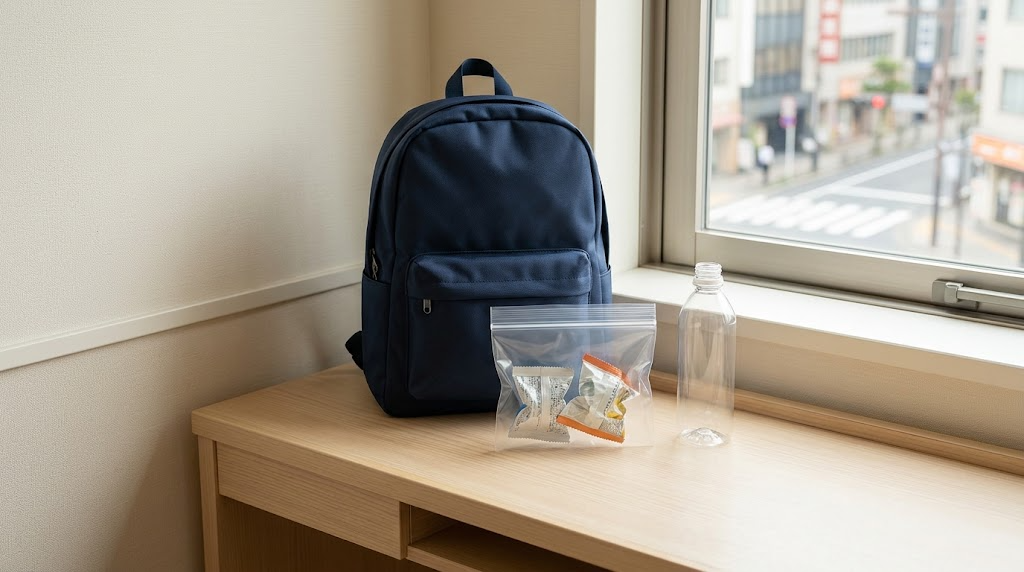
You have finished an onigiri and a drink, but there is no obvious place to put the wrapper or empty bottle. What should you do?
Carry a small bag, look for a bin that accepts your item, and keep your rubbish with you if you cannot find one. Public bins can be limited in Japan, as JNTO explains. That does not mean there are no bins anywhere—or that every bin you see accepts everything.
This guide covers small everyday travel waste, such as empty drink bottles, cans, and food packaging.
- No bin nearby? Start with these three steps
- What are you trying to throw away?
- Where to look for a suitable bin
- The box beside a vending machine is for recycling
- Read the label: a quick sorting guide
- Back at your accommodation
- Useful Japanese: asking where to put it
- Quick answers to common questions
- A simple habit for a smoother day out
- Sources and image note
No bin nearby? Start with these three steps
- Contain it: put wrappers in a small bag that closes securely. Keep anything wet from leaking into your day bag.
- Check before using a bin: read the item labels and any customer-only instructions. Use the matching opening, not just the nearest one.
- Keep it if necessary: take it back to your accommodation and ask where to sort and dispose of it.
A spare reused bag is useful; a separate leak-resistant pouch can help with messy packaging. GO TOKYO advises visitors to check bin labels and carry their rubbish when no suitable bin is nearby.
What are you trying to throw away?
| Your item | Where to look and what to check |
|---|---|
| Empty PET drink bottle or drink can | Look for an opening marked ペットボトル (PET bottles) or 缶 (cans) at a station you are using, a shop, or a vending-machine collection box. Empty the container first and follow the pictured items. |
| Food wrapper, used tissue, or paper packaging | Check the shop where you bought food or a station’s waste bins. Use a bin whose label accepts that item. Tissues and some paper packaging may go in 燃えるごみ (burnable waste); plastic wrappers may have a separate category. |
| Takeaway cup or food container | Ask the shop where you bought it about disposal. These items do not belong in bottle-and-can openings. Use a waste bin that accepts them, and ask about any remaining liquid before disposal. |
For all three: the places above are candidates, and some shops or stations have no usable bin. Follow customer-only notices and the accepted items on each opening; otherwise, keep the item for a suitable disposal point or your accommodation.
Where to look for a suitable bin
Convenience stores and the shop where you bought food
Before walking away with takeaway food, look for the shop’s disposal instructions or ask where to put the packaging afterward. Kyoto’s official visitor guidance recommends buying takeaway from businesses that provide waste containers. Kyoto Travel: responsible travel
At a convenience store, look for a customer bin and the shop’s disposal instructions. Buying something does not automatically give permission to unload rubbish collected elsewhere. Ask staff if the instructions are unclear.
Station concourses and platforms during your journey
When you are using a station, check the concourse or platform for labelled bins, or ask station staff. Do not enter a paid area just to search for one.
JR East describes its station waste-sorting and recycling initiatives (Japanese), including recycling stations with more detailed categories at selected stations.
Visitor facilities and designated public bins
If you are already using a shopping centre or tourist facility, look for marked bins or ask staff.
In Kyoto, the official tourism website links to a public trash-can map. It is a local tool, not a map of all Japan. Check the actual bin’s labels and access conditions when you arrive.
The box beside a vending machine is for recycling
The collection box beside a soft-drink vending machine is intended to collect empty containers from soft drinks sold through vending machines for recycling, as the Japan Soft Drink Association explains (Japanese). It is not a general-purpose public bin. Check that box’s accepted items and any instructions about which containers it accepts.

My takeaway coffee cup is a drink container too. Can it go in that box?
A takeaway cup does not belong in a bottle-and-can opening. Check the accepted containers on the label. Keep cups, food wrappers, and leftovers for a suitable waste bin.
Use the correct opening for the accepted empty bottle or can, and do not put remaining drinks into the recycling box. The association identifies both leftover liquid and plastic coffee cups as problems for this collection system. Why the contents of the box matter (Japanese)
If your drink is unfinished, finish it when convenient or ask staff about an appropriate liquid-disposal point. Secure the lid if the container has one; keep an open can upright and do not pack it with loose wrappers. Do not pour it into the recycling box or onto the street.
Read the label: a quick sorting guide
Waste categories and accepted items differ by municipality and facility. The words and pictures on the bin matter more than its colour. JNTO describes the broad categories, but they are not one nationwide sorting chart. JNTO: recycling and disposing of trash
| Label and reading | Meaning and what to check |
|---|---|
| ペットボトル petto botoru | PET bottles. This does not mean every plastic item: cups, bags, and food trays are different. |
| 缶 / かん kan | Cans. Follow the pictured examples and any instructions about emptying them. |
| 燃えるごみ / 可燃ごみ moeru gomi / kanen gomi | Burnable waste. Whether a particular plastic wrapper belongs here depends on the local system. |
| びん / ビン bin | Glass bottles. Do not assume a PET-bottle opening accepts glass. |
| 燃えないごみ / 不燃ごみ moenai gomi / funen gomi | Non-burnable waste. Check the listed items rather than treating it as a bin for anything uncertain. |
| プラスチック / プラ purasuchikku / pura | Plastic collection. Check which products or packaging it accepts and whether they must be clean. |
PET-bottle caps and labels: outside versus back at your accommodation
At a public collection box: empty the PET bottle and follow that box’s instructions for caps and labels. Use a separate cap opening if provided. If required preparation cannot be done there, keep the bottle for later. Put any removed small parts in a pouch so they do not get lost.
When preparing PET bottles for recycling later: the Japan Soft Drink Association recommends removing caps and labels and rinsing the bottle. At your accommodation, follow the host’s or staff’s instructions for the bottle and the removed parts. This general preparation advice does not mean every public collection box requires you to wash a PET bottle on the spot. PET-bottle preparation and local cap-collection rules (Japanese)
Would it be easier to squeeze every wrapper inside the empty bottle until I find a bin?
Keep them separate. Wrappers are easier to sort in their own small bag, and the bottle stays free of other rubbish for recycling.
Back at your accommodation
Ask which bin or collection area to use for your day’s rubbish. If you are staying in a rental apartment, follow the host’s instructions about separation, bags, and collection times. Do not copy a neighbour’s bin use or put bags at a residential collection point without confirmation from your host.
If the room bin is full, ask reception or the host for help rather than leaving bags in the hallway. This guide covers ordinary small travel waste; arrange disposal separately for broken suitcases, batteries, or other items that need special handling.
Useful Japanese: asking where to put it
You can show the item while asking. These phrases ask for guidance; they do not mean the staff must accept your rubbish.
- ごみ箱はどこですか?
Gomibako wa doko desu ka?
Where is the trash can? - これはどこに捨てればいいですか?
Kore wa doko ni sutereba ii desu ka?
Where should I throw this away? - ここに捨ててもいいですか?
Koko ni sutete mo ii desu ka?
May I throw it away here?
Quick answers to common questions
Are there really no public trash cans in Japan?
There are public bins, but you cannot count on finding one whenever you need it. A small bag lets you continue sightseeing instead of making your next stop depend on a bin.
What if a bin is full or closed?
Keep your rubbish and try another permitted disposal point, or ask staff. Do not leave a bag beside or on top of the bin.
Does “take your rubbish home” mean taking it back to my country?
For day-to-day sightseeing, the practical option is to bring it back to your accommodation and follow its disposal instructions. You do not need to keep ordinary snack wrappers for your flight home.
A simple habit for a smoother day out
Pack a small bag before leaving, keep drink containers separate, and check labels when you find a bin. If the right disposal point is not clear, ask—or carry it a little longer.
Planning a convenience-store stop? Our onigiri guide explains popular fillings and numbered wrappers.
Sources and image note
Checked on 30 September 2026. Sources are linked beside the relevant explanations: JNTO, GO TOKYO, Kyoto Travel, JR East, and the Japan Soft Drink Association. Bin locations, access, and sorting arrangements can change; the site’s current signs and staff instructions take priority.
The featured image is AI-generated and illustrates carrying small travel waste. It does not show a specific hotel or an official waste-sorting system.
コメント