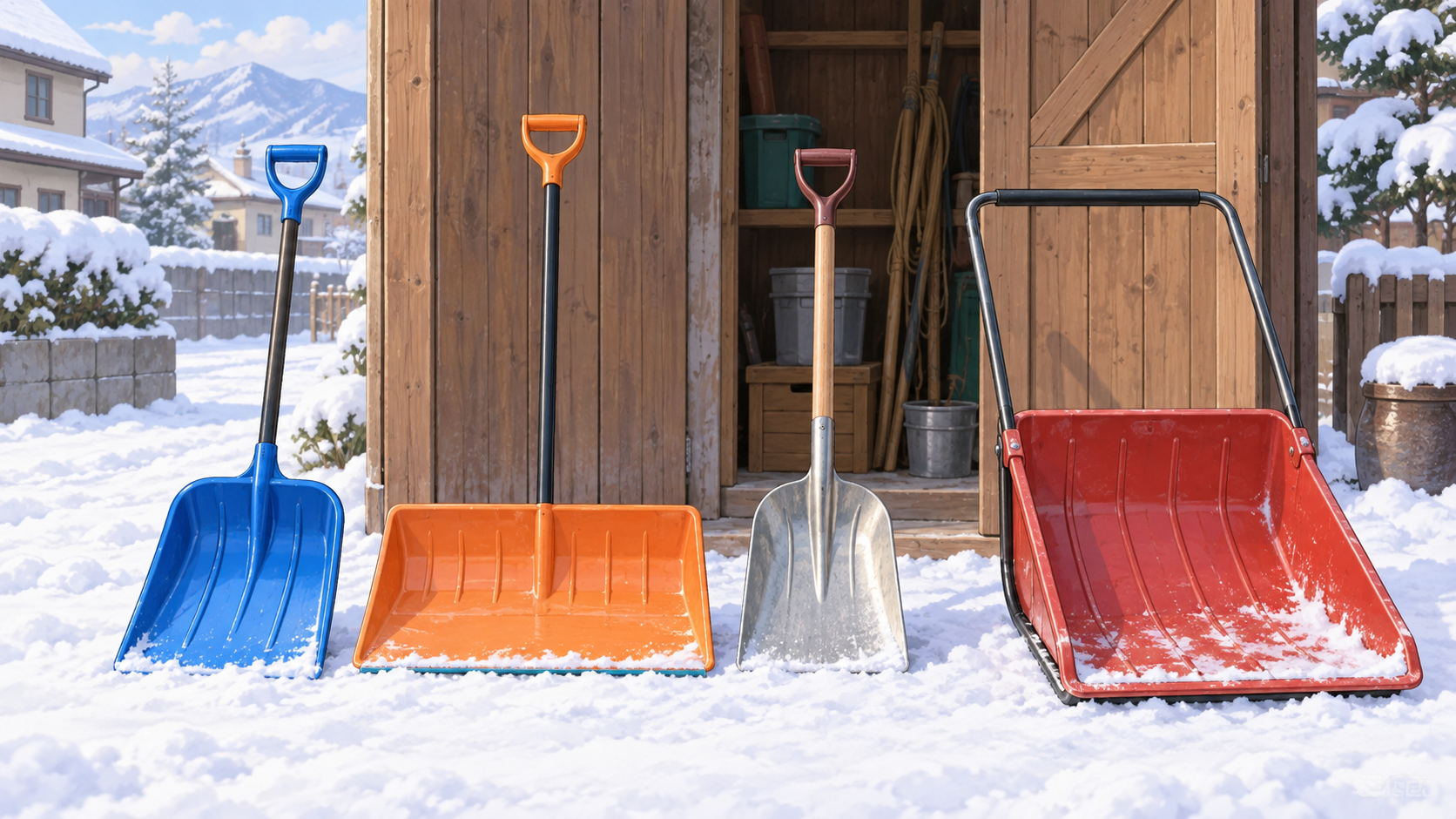
Snow removal in Hokkaido is not always a one-tool job. I choose my tools according to the depth and condition of the snow, the space available, and how far I need to move it.
My regular setup is a plastic snow shovel, a snow pusher, a metal shovel, and a Mama-san Dump. This guide explains how I use them around home. These are my working habits, rather than a rule that every household needs the same four tools.
Snow Removal Tools I Use in Hokkaido
From my experience in Hokkaido, I regularly use several different tools for snow removal.
Each tool has a different role. Some are better for pushing light snow, some for breaking up hard snow, and others for transporting larger amounts of snow.
The four tools I use most are a plastic snow shovel, a snow pusher, a metal shovel, and a Mama-san Dump.
| Tool | My main use | Typical situation |
|---|---|---|
| Plastic snow shovel | Scoop loose snow and open a working area | Deep snow or a tight space |
| Snow pusher | Push and gather snow | A thin layer of light snow |
| Metal shovel | Break compacted snow into manageable pieces | Hard snow |
| Mama-san Dump | Slide collected snow to its storage place | More snow to move, with room to maneuver |
Plastic Snow Shovel
A lightweight plastic snow shovel is useful for scooping and moving loose snow by hand.
I especially use one when a lot of snow has accumulated and I need to clear a small working area first.
Because it is smaller and easier to maneuver than a Mama-san Dump, I can use it to make enough space to move around and begin creating a route for transporting the snow.
Snow Pusher
A snow pusher has a wide blade designed to push snow along the ground rather than repeatedly scoop and throw it.
I mainly use it when a thin layer of light snow has accumulated.
I can push the snow to the side if it does not need to be moved far, or gather it into one place so I can transport it later with a Mama-san Dump.
Metal Shovel
A metal shovel is heavier than the plastic shovel, but its stronger blade is useful when the snow has become hard or compacted.
I use it to break large, hard chunks of snow into smaller pieces.
Once the snow has been broken up, I can move the pieces with a Mama-san Dump.
Mama-san Dump / Snow Dump
A Mama-san Dump, also called a snow dump, is the tool I use mainly for transporting larger amounts of snow.
Instead of repeatedly lifting and carrying snow, I can load snow into its large tray and slide it along the ground to the place where I want to leave it.
Because the tool itself is fairly large, however, I need enough room to maneuver it. This becomes especially important after heavy snowfall, when I may need to clear some space with a shovel before I can use the Mama-san Dump effectively.
Want to know more about this uniquely familiar snow-removal tool in Japan? Read my guide: What Is a Japanese Snow Dump? Hokkaido’s Snow Removal Tool Explained
How I Choose a Tool for Different Snow Conditions
The tool I start with depends largely on the amount and condition of the snow.
In practice, I often use more than one tool for the same snow-removal job. One tool may be useful for gathering or breaking up the snow, while another is better for transporting it.
When the Snow Is Light and Shallow
When only a thin layer of light snow has fallen, I usually start with a snow pusher.
If there is enough space nearby, I may simply push the snow to the side. If the snow needs to be removed from the area completely, I gather it into one place first.
I can then load the collected snow into a Mama-san Dump and transport it to the place where I leave the snow.

So you don’t always need to shovel light snow?

Not in my experience. If the snow is light and there isn’t much of it, I often find it easier to just push it together.
When a Lot of Snow Has Accumulated
When a lot of snow has accumulated, I usually start with a plastic snow shovel.
One reason is that a Mama-san Dump is fairly large. If the snow is deep everywhere, there may not be enough room to move or turn it easily.
I first use the plastic shovel to clear a working area and gradually create a route toward the place where I will eventually leave the snow.
At this stage, I temporarily pile the shoveled snow somewhere nearby. Once I have enough room to use the Mama-san Dump, I load the piled snow into it and transport it to the final snow-storage area.
This means that even though the Mama-san Dump does most of the transporting, a smaller shovel can be important for preparing the space needed to use it.
Why not use the Mama-san Dump from the beginning?
Sometimes there just isn’t enough room. After heavy snowfall, I first use a smaller shovel to make space for the Mama-san Dump and create a route for moving the snow.
When the Snow Is Hard or Frozen
Large, hard chunks of snow can be difficult to handle with a plastic shovel or a Mama-san Dump.
In that situation, I use a metal shovel to break the hard snow into smaller pieces first.
Once the pieces are small enough to handle, I load them into the Mama-san Dump and transport them away.
For me, the metal shovel and Mama-san Dump have very different roles: the metal shovel breaks up the hard snow, while the Mama-san Dump transports it.
Why I Often Use More Than One Snow Tool
From my experience in Hokkaido, snow removal is often easier when I use several tools for different parts of the job.
I don’t expect one tool to do everything.
A snow pusher can gather light snow. A plastic shovel can help create working space after heavy snowfall. A metal shovel can break up hard snow. And a Mama-san Dump can transport the snow once it is ready to be moved.
I think of the process in three basic steps:
Break it up → Gather it → Transport it
Not every snowfall requires all three steps. With a thin layer of light snow, simply pushing it aside may be enough. But when there is a lot of snow—or when it has become hard and compacted—using different tools for different jobs makes more sense to me.
So there isn’t really one snow tool that replaces all the others?
That’s how I see it. Each one does a different job, so I usually choose the tool based on the snow and what I need to do with it.
Decide Where the Snow Will Go
Before gathering snow, decide where it can stay and how you will reach that spot. If you rent or share a property, confirm the snow-storage arrangement with the landlord or property manager.
Do not interpret “push it to the side” as permission to push snow onto a public road. Sapporo City asks residents not to put snow from their property onto the road, because it obstructs traffic and can cause accidents. For other municipalities, check their own guidance.
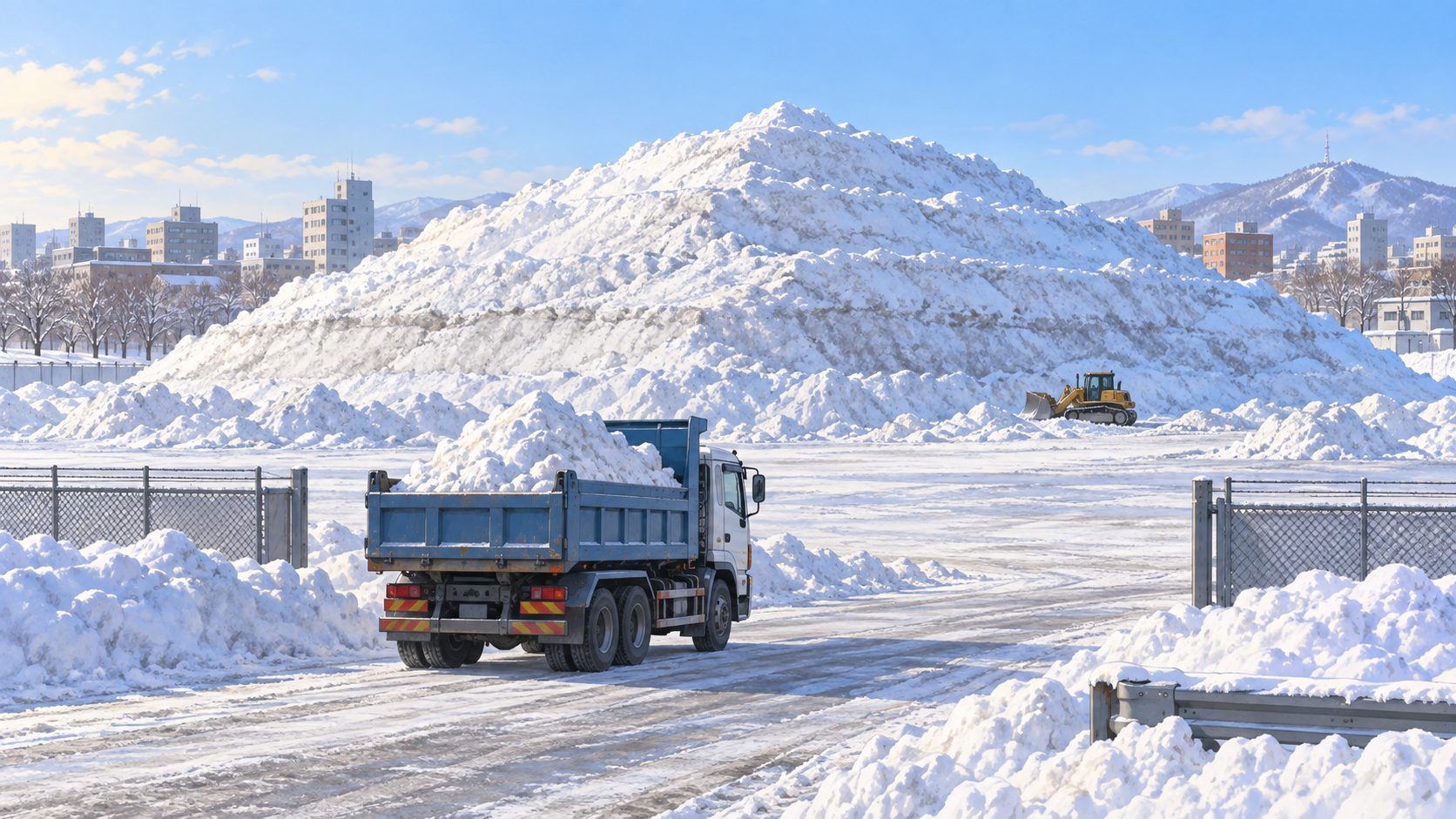
A hand-operated snow dump is different from a dump truck or a snow disposal site. Our guide to Sapporo’s large snow piles and snow disposal sites explains where snow hauled from roads goes.
A Short History of Snow Removal Tools in Hokkaido
The snow-removal tools used in Hokkaido have changed over time.
According to the Hokkaido Museum, people once used wooden and bamboo tools such as the kaesuki, kosuki, and jonba, as well as steel shovels, to clear snow.
The museum traces a snow-pushing tool called the yukioshi to the 1950s, when it was mainly used at railway stations. Tools based on this type of design were later commercialized as products called the Mama-san Dump or Snow Dump and became popular in snowy areas of Hokkaido and elsewhere.
Looking at this history, I find it interesting that some of the basic ideas behind snow removal are still familiar today: pushing snow, breaking it up when necessary, and finding an efficient way to move it.
Final Thoughts
From my experience in Hokkaido, there isn’t one snow-removal tool that I use for every situation.
When the snow is light and shallow, a snow pusher can be enough to move it aside or gather it in one place. When a lot of snow has accumulated, I usually start with a plastic shovel to create enough working space and a route for the Mama-san Dump. And when the snow has become hard or frozen, I use a metal shovel to break it into smaller pieces first.
The Mama-san Dump often comes in at the final stage, when I need to transport the collected snow to the place where I will leave it.
For me, snow removal is less about finding one perfect tool and more about using the right tool for each part of the job.
Push it, break it up, gather it, and transport it—the order depends on the snow in front of me.
So even on the same driveway, the tools you use can change depending on the snow?
Exactly. That’s one of the things winter in Hokkaido has taught me. I look at how much snow there is and what condition it’s in, then decide how to tackle it.
The working examples come from the author’s experience in Hokkaido. Historical and municipal references were checked on 21 September 2026. Character images are illustrations.
Watch More with Sora & Yuki
Prefer a quick video? Sora and Yuki explain everyday life in Japan on our official YouTube and TikTok accounts. Subscribe or follow for more Practical Japan Guide videos.
YouTube — @practicaljapanguide
TikTok — @practical_japan_guide
Start with our related short, Why Is Snow Still Beside the Road? It explains the difference between clearing a road and hauling snow away: watch on YouTube or watch on TikTok.

コメント